English



Analysis of Transmitter (TOSA) and Receiver (ROSA) devices of optical module
The role of optical modules in optical communication networks is photoelectric conversion. And they are the core components for photoelectric conversion in optical communication systems. Many engineers and buyers ask: what optical devices are mainly composed of optical modules? What are TOSA and ROSA? What roles do they play in optical transceivers? How do TOSA, ROSA and BOSA work together? This article will give you a full analysis of the internal structure, working principle and performance indicators of TOSA and ROSA, helping you better understand optical module design and selection. ETU-LINK will reveal the answer for everyone.
First of all, the two most important parts of the optical transceiver are the optical transmitting assembly (TOSA) and the optical receiving assembly (ROSA). Among them, the optical transmitting assembly (TOSA) mainly plays the role of converting electrical signals into optical signals (E/O ), judging its performance indicators mainly include optical power and threshold.
I. What Is TOSA (Transmitter Optical Subassembly)?
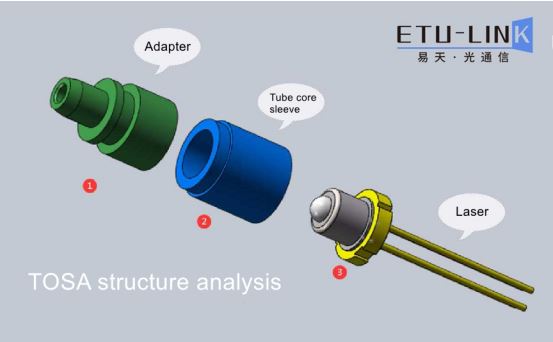
TOSA is mainly composed of a laser (TO-CAN), an adapter, and a die sleeve. In the long-distance optical module, an isolator and an adjustment ring are also added. The isolator plays the role of anti-reflection, and the adjustment ring is used to adjust the focal length. effect.
TOSA is the transmitting core of the optical module. It drives the internal laser diode to convert high-speed electrical signals into stable optical signals for transmission through optical fibers. It is widely used in 10G SFP+, 25G SFP28, 100G QSFP28 and other optical transceivers.
II. What Lasers Are Used in TOSA?
The light emitting device includes FP, DFB, VCSEL, EML, etc. The light emitting device generally integrates a laser diode (LD Chip), a backlight detection tube (PIN Chip), a thermistor, a TEC cooler and an optical Alignment mechanism and other components.
Different lasers correspond to different transmission distances and rates:
1) VCSEL for short-range multimode;
2) FP for low-speed short-distance;
3) DFB for middle/long-distance single-mode;
4) EML for high-speed long-haul transmission above 100G.
III. What Is ROSA (Receiver Optical Subassembly)?
The function of the optical receiving component (ROSA) is to convert the optical signal into an electrical signal (O/E), and its performance indicators are mainly sensitivity (SEN), and the ROSA is composed of a detector and an adapter. TIA, APD-TIA, the adapter has two kinds of metal and plastic PE parts.
ROSA is the receiving core of the optical module. It receives optical signals from the fiber, converts them into weak electrical signals through photodetectors, and amplifies them through TIA/APD-TIA circuits to restore stable digital electrical signals.
Common detectors include PIN and APD. PIN has low cost and is suitable for short-to-medium distance; APD has higher sensitivity and is used in long-distance and low-light receiving scenarios.
IV. What Is BOSA? Why Is It Used in BiDi Modules?
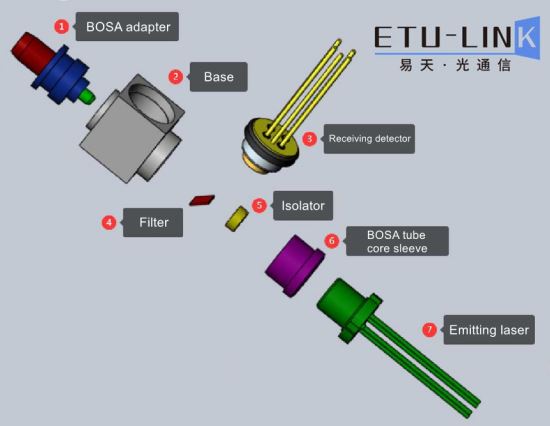
In addition, the optical transmitting and receiving component of BIDI single-fiber optical module is BOSA, which consists of laser, adapter, filter, base, detector, isolator and die sleeve. BOSA is the main component of BiDi single fiber optical module.
BOSA (Bi-Directional Optical Subassembly) integrates TOSA and ROSA in one component, using wavelength division multiplexing (WDM) to realize sending and receiving on a single optical fiber. It saves fiber resources by 50% and is widely used in base station fronthaul, PON, and access networks.
V. FAQ: Common Questions About TOSA, ROSA and BOSA
1. What is the core difference between TOSA and ROSA?
TOSA converts electrical → optical (E/O) for signal transmission; ROSA converts optical → electrical (O/E) for signal reception. They are a pair of complementary components in the optical module.
2. What performance indicators determine TOSA quality?
Main indicators: optical output power, extinction ratio, threshold current, side mode suppression ratio (SMSR), working temperature range, isolation degree.
3. What performance indicators determine ROSA quality?
Main indicators: receiving sensitivity, saturation optical power, response speed, dark current, noise level.
4. Can TOSA and ROSA be used independently?
No. They must be equipped with driver chips, control circuits, and housings to form a complete optical module. They are core internal devices and cannot be used alone.
5. What is the difference between BOSA and TOSA+ROSA?
BOSA integrates transmit and receive in one device for single-fiber bidirectional (BiDi). Traditional modules use separate TOSA and ROSA for dual-fiber transmission.
Last updated: May 13, 2026
Categories
New Blog
Tags
For inquiries about our products or pricelist, please leave your information with us and we will be in touch with in 24 hours.


 Factory: Right Side Of 3rd Floor, No. 102 Building, Longguan Expressway, Dalang Street, Longhua District, Shenzhen
Office: Floor 4, Building 4, Nanshan Yungu Phase ll, Taoyuan Community, XiliStreet,Nanshan District, Shenzhen
© Copyright: 2026 ETU-Link Technology CO ., LTD All Rights Reserved.

IPv6 network supported
Friendly Links:
易天官网