English




What are the reasons for the failure of the optical module
As a photoelectric integrated product used to realize photoelectric conversion in optical fiber communications, optical modules are now widely used in data centers, fiber to the home, local area networks, base stations and other fields. Many users ask: Why do optical modules fail? What causes module damage? How to prevent optical module failures?
In the process of using the optical module, it is inevitable that there will be abnormal usage. Next ETU-LINK will introduce several main reasons for the failure of the optical module.
I. Why Does Static Electricity (ESD) Damage Optical Modules?
The optical module is damaged by static electricity (ESD damage)
The discharge process of static electricity is very fast, and static electricity can also produce a huge strong electromagnetic pulse, which will cause serious damage to the optical module. At the same time, when the dust accumulated to a certain extent, it will change the impedance between the lines, which will not only affect the normal use of the optical module, but also shorten the life of the optical module.
ESD can breakdown internal lasers, diodes, and chips instantly—often without visible appearance damage. Low-humidity environments, human body contact, and improper operation are the main causes.
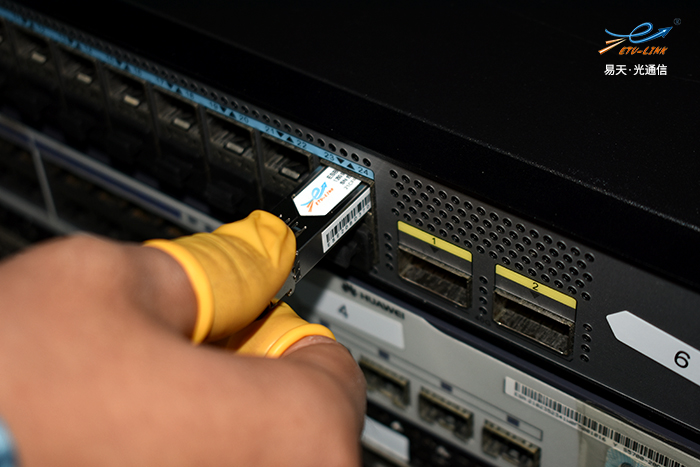
Therefore, when using the optical module, avoid too dry environment, and do not touch the electrostatic sensitive parts of the optical module with bare hands without electrostatic protection. We need to wear finger cots or anti-static bracelets when we plug in and out the optical module to prevent the optical module from being damaged by static electricity.
Best ESD protection: use anti-static wrist straps, anti-static mats, and avoid touching the golden fingers and optical port directly.
II. Why Does Optical Port Pollution Cause Module Failure?
The optical port of the optical module is polluted
If the optical port is exposed in the air for a long time, the optical port of the optical module may be polluted by dust. Therefore, the optical module needs to insert the dust plug in time when the optical fiber is not inserted or removed.
Dust, oil, or scratches on the optical port cause increased insertion loss, low receive power, link instability, packet loss, and even complete link failure. Contamination is one of the most common failure reasons in field applications.
Recommended maintenance: clean optical ports with fiber cleaning swabs and cleaning solution; install dust caps when unused; avoid touching the lens with fingers.
III. Why Do Optoelectronic Devices Fail Inside the Module?
1. Photoelectric device failure
The failure of optoelectronic devices is generally manifested in the corrosion or degradation of the materials of lasers and detectors. The failure of photoelectric conversion devices will cause the optical and electrical signals to be unable to accurately communicate.
2. Causes of Laser Failure
The causes of laser failure can be attributed to three categories: low optical power, no optical signal output, and excessive noise. The light power is too low because the threshold current of the laser itself is too high, the quantum efficiency is low, or the external driving current is too small. Among them, the reason for the excessively high threshold current comes from the dark line defect and temperature rise of the laser itself. These two failures are caused by mechanical damage, defect propagation, stress and lattice mismatch, cavity surface aging, emission surface pollution, etc. .
3. Causes of Detector Failure
The cause of the detector failure can be attributed to three categories: excessive noise, no electrical signal output, and low response. Among them, the main reasons for the excessively low response are reduced quantum efficiency, contamination of the photosensitive surface, or crack damage on the optical window surface. The decrease in quantum efficiency is affected by temperature and material grouping, causing the response wavelength to shift. The pollution of the photosensitive surface or the damage of the cracks on the optical window surface will affect the absorption and recombination of photons, which is unfavorable to the generation of photocurrent.
Common faulty devices: LD laser, PIN/APD detector, TIA amplifier. These are core components; once degraded, the module cannot work properly.
IV. Why Does Circuit Failure Lead to Module Abnormality?
Circuit failure
① The failure of the driving circuit of the transmitting part will cause the mismatch of the laser working current;
② Failure of the amplifier circuit in the receiving part will increase the sensitivity of the detector.
Circuit faults include driver chip damage, abnormal bias current, abnormal voltage, and amplifier failure. These result in unstable optical power, poor sensitivity, link drops, and inability to link. Most circuit failures are caused by surge, lightning interference, unstable power supply, or component aging.
Ⅴ. How to Predict Optical Module Lifetime by DDM?
We can monitor the condition of the laser through the optical transceiver DDM digital diagnostic monitoring function. Because the quantum efficiency of the laser will decrease with the increase of the use time of the laser, we can detect the bias current of the laser to predict the life of the laser.
Generally, the service life of the optical module products supplied by ETU-Link Technology Co., Ltd. manufacturers is 3-5 years, which conforms to the international unified standards and continuously protects your network communication.
Mostly caused by ESD damage, optical port pollution, incompatible wavelength/distance, or device aging.
Use DDM to check Tx/Rx power, bias current, and voltage. Abnormal values indicate failure.
Yes. Dust causes high loss and may scratch the optical port, leading to permanent failure.
Normal use: 3–5 years. High-quality modules: up to 5–8 years.
ETU-LINK provides high-reliability optical modules with stable performance, long service life, and complete DDM function, widely used in data centers, 5G base stations, enterprise networks, and security monitoring systems.
Last updated: May 15, 2026
Categories
New Blog
Tags
For inquiries about our products or pricelist, please leave your information with us and we will be in touch with in 24 hours.


 Factory: Right Side Of 3rd Floor, No. 102 Building, Longguan Expressway, Dalang Street, Longhua District, Shenzhen
Office: Floor 4, Building 4, Nanshan Yungu Phase ll, Taoyuan Community, XiliStreet,Nanshan District, Shenzhen
© Copyright: 2026 ETU-Link Technology CO ., LTD All Rights Reserved.

IPv6 network supported
Friendly Links:
易天官网