English



Analysis of TOSA and ROSA devices in optical modules
As core components for photoelectric conversion in optical communication systems, data center interconnection, and long-haul transmission, optical modules rely on TOSA and ROSA to realize high-speed signal conversion. Now, ETU-LINK will introduce to you the components of the optical module—TOSA and ROSA.
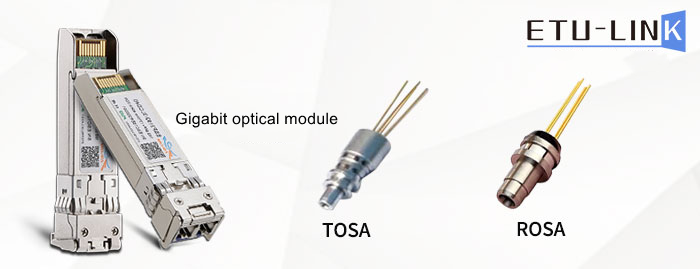
1. What Is TOSA in Optical Modules?
TOSA is the main component of the optical transmitter module, whose main function is to convert electrical signals to optical signals. TOSA can be divided into SC TOSA, LC TOSA, FC TOSA, ST TOSA according to the adapter type. TOSA includes components such as optical isolator, monitoring photodiode, LD drive circuit, thermistor, thermoelectric cooler, automatic temperature control circuit (ATC), and automatic power control circuit (APT).
The light source (semiconductor light-emitting diode or laser diode) is the core. LD chip, monitoring photodiode and other components are packaged in a compact structure (TO coaxial package or butterfly package), and then constitute TOSA.
In TOSA, LD laser diode is currently the most commonly used semiconductor emitting device for optical modules. It has two main parameters: threshold current (Ith) and slope efficiency (S). In order to make the LD work quickly, we must provide the LD with a DC bias current IBIAS slightly larger than the threshold current, that is, the laser is emitted when the forward current exceeds the threshold current.
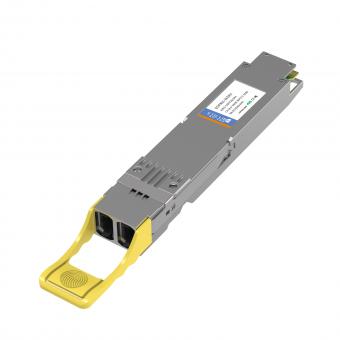
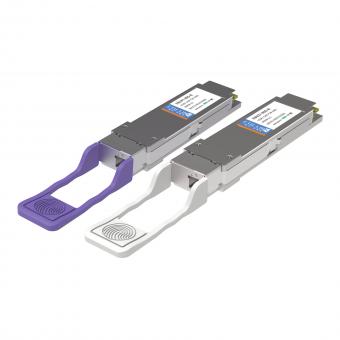
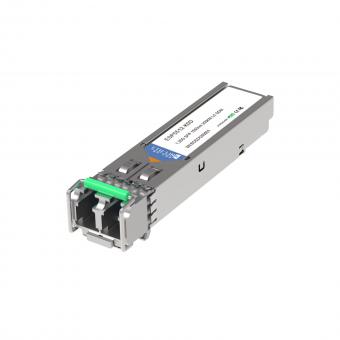
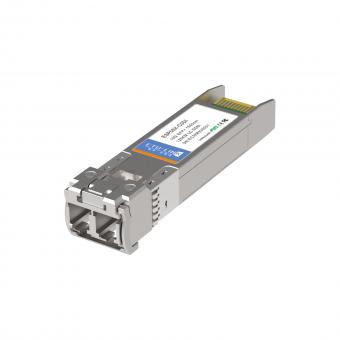
TOSA is widely used in 1.25G SFP, 10G SFP+, 25G SFP28, 40G QSFP+ and 100G QSFP28 optical modules, supporting 850nm, 1310nm, 1550nm, CWDM and DWDM wavelengths.
2. What Is ROSA in Optical Modules?
ROSA is a light receiving component. In high data rate optical modules, PIN or ADP photodiodes and TIA are usually assembled in a sealed metal casing to form our light receiving components.
The photodetector, the main component of the receiving component ROSA, is mainly used to convert optical signals into electronic signals through the photoelectric effect. Common photodetectors in optical communication are PIN photodiodes and avalanche photodiodes (APD). APD is a high-sensitivity photodetector that uses avalanche multiplication effect to double the photocurrent. Compared with PIN photodiodes, the sensitivity of APD receivers can be increased by 6~10dB.
ROSA matches with TOSA to complete full duplex optical communication. PIN ROSA is used for short and medium distance transmission, while APD ROSA is used for long-distance and high-sensitivity scenarios such as 10G ER / ZR and 100G long-haul modules.
The above is the TOSA and ROSA related knowledge compiled by ETU-LINK. TOSA and ROSA, as the core components of the optical module, play an important role in photoelectric conversion.
TOSA completes electrical-to-optical conversion (E/O) at the transmitter end, and ROSA completes optical-to-electrical conversion (O/E) at the receiver end. Together they support stable high-speed transmission for data centers, enterprise networks, telecom backbones, and 5G fronthaul networks.
Last updated: April 13, 2026
Categories
New Blog
Tags
For inquiries about our products or pricelist, please leave your information with us and we will be in touch with in 24 hours.


 Factory: Right Side Of 3rd Floor, No. 102 Building, Longguan Expressway, Dalang Street, Longhua District, Shenzhen
Office: Floor 4, Building 4, Nanshan Yungu Phase ll, Taoyuan Community, XiliStreet,Nanshan District, Shenzhen
© Copyright: 2026 ETU-Link Technology CO ., LTD All Rights Reserved.

IPv6 network supported
Friendly Links:
易天官网