English



APC VS UPC, which one to choose?
When talking about passive products, like patch cord, pigtail, adapter and splitter, will involve UPC and APC description. Many users ask: what is LC/UPC - LC/UPC? What is SC/APC - SC/APC? What are UPC and APC? What is the difference between APC and UPC connectors? Can APC and UPC be mixed? How to choose the right fiber polish for my project?
In fact, UPC and APC are two grinding methods for optical fiber bushings. This guide will explain everything clearly to help you make the best choice for data centers, telecom, FTTx, and LAN applications.
I. What Are UPC and APC in Fiber Optic Connectors?
1. What is UPC&APC?
Install connectors on one fiber end face, return loss is unavoidable, this is due to the reflection of the optical source. Serious optical loss will damage the laser optical source and interrupts the transmission of signals. Therefore, connector rings with different grinding methods can avoid severe echo loss to a certain extent. UPC and APC are two widely used grinding types.
UPC and APC define the polishing shape of the fiber connector endface, which directly affects return loss (RL), insertion loss (IL), and signal transmission quality. They are critical for stable fiber communication in CATV, PON, WDM, data centers, and long‑distance transmission systems.
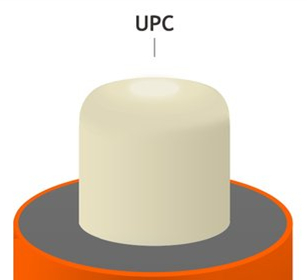
UPC, ultra physical contact, evolved from PC and has better surface finish. UPC connector depends on machine polishing, low return loss.
UPC features a slightly curved, non‑angled polished endface for tighter physical contact. It is the most common type for general Ethernet, data center, and enterprise LAN connections, offering good performance at an affordable cost.
3. What is APC (Angled Physical Contact)?
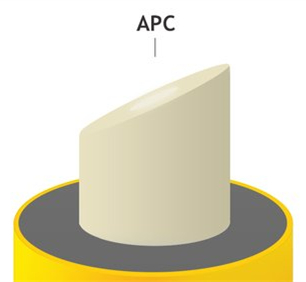
APC, angular physical contact. The end face is drawn to a 8 degree angle, which is beveled to reduce reflection. APC can only be connected to APC. Since the structure of the APC is completely different from the UPC, if the two connectors are connected with a flange, the optical fiber end of the connector will be damaged.
APC uses an 8° angled endface design to reflect light away from the core into the cladding, drastically reducing backreflection. It is the preferred choice for systems sensitive to return loss, such as FTTx, PON, CATV, RF over fiber, and WDM systems.
II. How to distinguish APC vs UPC Connectors?
When choosing an optical patch cord, it should be based on your actual application. APC connector performance is better than UPC. APC is best suited for high bandwidth applications and long distance links. Such as FTTx, passive optical network(PON) and Wavelength division multiplex(WDM) are more sensitive to return loss. Therefore, the APC is a better solution for providing the lowest return loss. However, extensive use of APC connectors will increase costs considerably. If the return loss requirement is not high, the UPC is a better choice.
Follow this simple selection rule for your fiber cabling project:
Choose UPC if you need standard performance, lower cost, and are building data center LAN, enterprise networks, storage networks, or short‑distance links.
Choose APC if you need ultra‑low return loss for FTTx, PON, CATV, RF over fiber, WDM, broadcast, or long‑haul telecom systems.
ETU-Link provides APC, UPC and other types of fiber optic jumper, low loss, cost-effective, is the best choice for optical communications cabling.
IV. FAQ: Common Questions About APC and UPC
1. Can I connect APC and UPC connectors together?
No. Never mix APC and UPC via adapters or couplers. The 8° angle mismatch will cause physical damage to fiber ends, high loss, poor return loss, and even equipment failure. Always match APC to APC and UPC to UPC.
2. What is the difference between PC, UPC, and APC?
PC → UPC → APC is an evolution. PC is basic physical contact; UPC is an improved ultra‑polished version; APC adds an 8° angle for lowest return loss. UPC is now widely used instead of older PC types.
3. Which is better: APC or UPC?
No absolute better. APC has better performance (lower return loss) but higher cost. UPC is more cost‑effective for most general applications. Choose based on your system’s return loss requirement.
4. What applications use UPC vs APC?
- UPC: Data centers, Ethernet, enterprise LAN, SAN, 10G/25G/100G data transmission
- APC: FTTx, PON, CATV, RF over fiber, WDM, broadcast, high‑sensitivity optical links
5. Are APC and UPC available for all connector types?
Yes. Both UPC and APC are available for LC, SC, FC, ST, and other common fiber connector formats, such as LC/UPC, SC/APC, FC/APC, etc.
Last updated: May 11, 2026
Previous :
OM5 VS OM3&OM4Next :
How to use optical patch cord correctly?For inquiries about our products or pricelist, please leave your information with us and we will be in touch with in 24 hours.


 13th Floor, Building 6, Honghualing Base, Nanshan Intelligent Manufacturing Base, Liuxian Avenue, Taoyuan Street, Xili, Nanshan District, Shenzhen, China
© Copyright: 2026 ETU-Link Technology CO ., LTD All Rights Reserved.

IPv6 network supported
Friendly Links:
易天官网