English




What is a Optical Engine?
The optical engine is a core component of an optical communication system. It is an integrated optical subsystem responsible for processing and transmitting optical signals, and its performance directly impacts the system's signal transmission.
The following is a detailed introduction to the optical engine:
I. Composition and Working Principle of the Optical Engine
(1). Composition: A light engine typically consists of multiple optical components, including a laser, lenses, mirrors, gratings, and an electronic control system. The laser serves as the light source, generating a high-energy laser beam. Lenses and mirrors are responsible for focusing and deflecting the beam. Gratings are used for spectral analysis and interferometry. The electronic control system enables precise control and adjustment of the entire system.
(2). Working Principle: An optical engine typically consists of a laser diode and a modulator. The laser diode generates laser light, while the modulator converts electrical signals into optical signals. In optical communication systems, the performance of the optical engine directly affects the transmission quality and speed of the entire system.
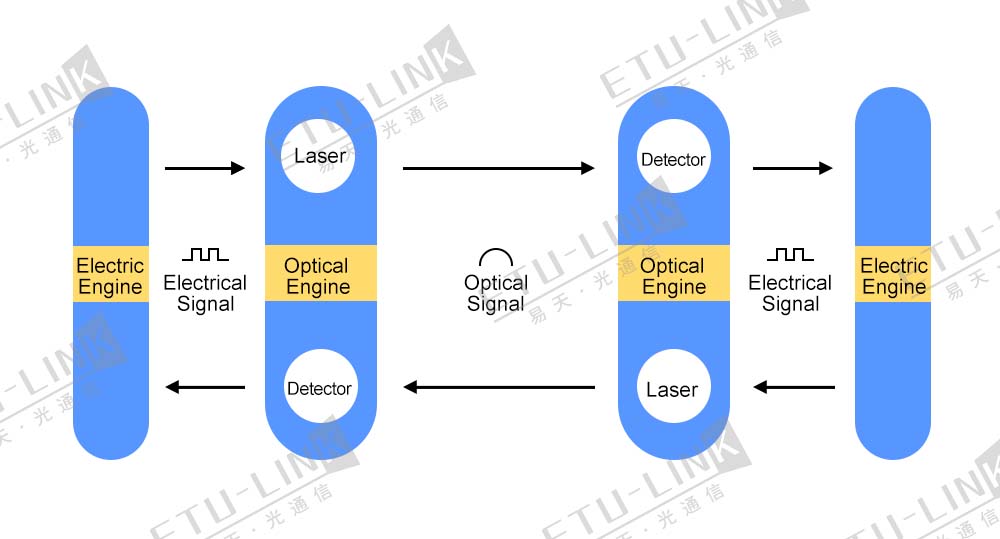
II. Application Areas of Optical Engines: Optical Communication Systems
(1). Data Center: The optical engine is used to improve network transmission speed and efficiency. It replaces electrical signals with optical signals to achieve high bandwidth, low latency, and long-distance transmission, meeting the needs of cloud computing, big data analysis, and other applications.
(2). Backbone Network: The optical engine supports long-distance, high-speed optical signal transmission, meeting the data transmission needs across regions (cities, provinces, countries).
(3). Industrial Manufacturing: In processes such as laser cutting, marking, and welding, the optical engine precisely controls the focus and intensity of the laser beam, enabling precision material processing and improving processing quality.
(4). Medical Field
Medical Imaging and Diagnosis: Light engines are widely used in equipment such as optical microscopy to achieve high-definition imaging of biological tissues and cell structures, assisting doctors in accurate diagnosis.
Laser Medical Aesthetics: Utilizing a light engine for laser treatments such as freckle removal and hair removal, achieving cosmetic results through precise laser processing.
(5). Scientific Research: Compatible with laboratory equipment such as Raman spectrometers and optical microscopes, it supports experiments such as spectral analysis, fluorescence imaging, and optical manipulation with precise beam control and adjustment.
(6). AR Glasses: As the core display component, they are responsible for generating and spatially modulating light to form virtual images. The mainstream technologies include self-emissive (such as micro-LED, OLED), reflective modulation (such as LCOS, DLP), and scanning (such as LBS), each with its own characteristics and challenges.
III. Technological Development Trends of Optical Engines
✅ High-speed: With the development of technologies such as cloud computing, the Internet of Things, and big data, the demand for high-speed data transmission in data centers is constantly growing, and optical engines will develop towards higher bandwidth and higher speed. For example, some companies have already launched 3.2T optical engines to meet the needs of next-generation AI computing platforms .
✅ Integration: By integrating more optical components and functions, optical engines can achieve higher integration and smaller size, facilitating their application in various devices. For example, CPO (co-packaged optics) technology integrates the optical engine with the chip, reducing power consumption by 30%-40% and significantly improving energy efficiency.
✅ Intelligentization: By combining artificial intelligence and machine learning technologies, the light engine will achieve more intelligent beam control and adjustment, improving the system's adaptability and performance.
IV. Market Prospects for Optical Engines
A. Market Growth: With the rapid development of fields such as optical communication, industrial manufacturing, medical care, and scientific research, the market demand for optical engines will continue to grow.
B. Changing Competitive Landscape: Currently, the global optical engine market is mainly dominated by Chinese and American companies, with European, Japanese, and South Korean manufacturers unlikely to catch up in the short term. However, with continuous technological advancements and market expansion, the competitive landscape may change.
Categories
New Blog
Tags
For inquiries about our products or pricelist, please leave your information with us and we will be in touch with in 24 hours.


 Factory: Right Side Of 3rd Floor, No. 102 Building, Longguan Expressway, Dalang Street, Longhua District, Shenzhen
Office: Floor 4, Building 4, Nanshan Yungu Phase ll, Taoyuan Community, XiliStreet,Nanshan District, Shenzhen
© Copyright: 2026 ETU-Link Technology CO ., LTD All Rights Reserved.

IPv6 network supported
Friendly Links:
易天官网