English




In the optical communication industry, when selecting and developing optical modules, companies often focus on speed, transmission distance, and compatible equipment, but rarely delve into the core optical component—the OSA (Optical Sub-module). In fact, the iterative upgrade of optical module speed is essentially an iteration of the OSA optical architecture, light emission principle, and signal c...

Optical module compatibility is crucial for stable network operation, and it mainly falls into two categories: hardware compatibility and software compatibility. Hardware ensures normal physical layer connection, while software enables module identification, link negotiation, and normal functioning. The vast majority of optical module port downtime, disconnections, and malfunctions are caused by h...

Looking at high-speed optical interconnects from the front lines of the industry, AI computing architecture is reshaping the demand curve for optical modules. Recent industry growth expectations have been continuously revised upwards, with 800G currently in a golden window for large-scale delivery, while the next-generation 1.6T is rapidly approaching. Leaving aside research report rhetoric, we'll...

China country has captured over 60% of the global optical module manufacturing capacity, but behind this impressive overall production capacity, high-end optical chips and high-speed DSP chips remain the weakest links in the industry chain. With the explosive growth of AI computing power, the accelerated adoption of 800G, and the commencement of 1.6T mass production, the self-sufficiency and contr...

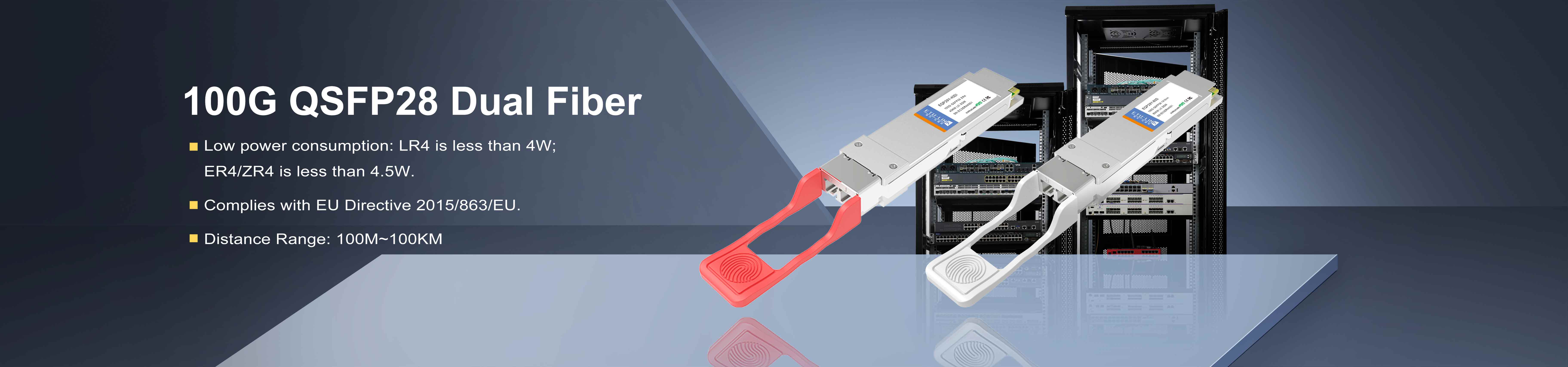
Smooth video streaming, instant cloud file transfers, and 24/7 high-speed operation of big data centers all rely on an unassuming "network hero"—the 100G QSFP28 optical module. Many people only know about its fast network speed, but they don't understand its true capabilities, applicable scenarios, or the most common pitfalls in choosing it. Today, we 'll use super easy-to-understand, practical in...
In the past, when discussing AI computing power, everyone's attention was focused on GPU and servers, but in 2026, the trend completely changed. From top-level documents from the Ministry of Industry and Information Technology and the National Development and Reform Commission to a series of support plans from Guangdong Province and Shenzhen, a series of important policies have been implemented in...

Hello, everyone working in networking, system integration, and telecommunications operations and maintenance! Friends often ask me: For remote base stations, field security, and the renovation of old government and enterprise dedicated lines, the business needs to run 25G and the distance needs to be 80km, but we only have single-core optical fiber left and do not want to lay new lines, is there a...

Ⅰ.Computing Power Constraints: The Bottleneck Lies in Transmission, and the Key Lies in Optical Modules Against the backdrop of the rapid expansion of the AI industry, the market has long focused on computing chips such as CPU and GPU, but has neglected optical communication hardware that carries massive data flows. In an interview, NVIDIA CEO Jensen Huang pointed out a key pain point i...
For inquiries about our products or pricelist, please leave your information with us and we will be in touch with in 24 hours.


 13th Floor, Building 6, Honghualing Base, Nanshan Intelligent Manufacturing Base, Liuxian Avenue, Taoyuan Street, Xili, Nanshan District, Shenzhen, China
© Copyright: 2026 ETU-Link Technology CO ., LTD All Rights Reserved.

IPv6 network supported
Friendly Links:
易天官网