English



Analysis of Challenges in 400G Optical Modules
With the rapid development of data centers, AI, and 5G transport networks, 400G optical modules have become a core necessity in the communications industry chain. Compared to the mature 100G optical modules, their large-scale deployment still faces many underlying technical and application challenges, directly restricting market penetration and affecting cost control and operational stability in downstream core scenarios.
Ⅰ. Technical Challenges: The Dual Constraints of Physical Limits and Performance Bottlenecks
1. Inherent Limitations of Modulation Technology: The Signal-to-Noise Ratio Dilemma Posed by PAM4
The mainstream 400G optical module uses PAM4 modulation technology to double the single-channel rate. Compared to 100G NRZ modulation, its level spacing is only 1/3, and the signal-to-noise ratio margin is compressed to 9.5dB. This makes it susceptible to bit errors caused by link interference, and it places extremely high demands on the precision of components such as lasers and detectors. Furthermore, PAM4 is highly dependent on high-speed DSP chips, which account for over 60% of the module's total power consumption, creating a vicious cycle of "performance improvement → DSP dependence → increased power consumption," thus creating potential risks in heat dissipation and cost.
2. Signal Integrity Challenges: Uncontrolled Link Loss in High-Speed Transmission
The 400G optical module achieves a single-channel rate of 106.24 Gbps. High-speed signal transmission faces three types of link losses:
First, the loss of electrical signals in the PCB board and connectors increases with the square of the frequency, requiring additional components for compensation and increasing module complexity.
Second, fiber dispersion and insertion loss in the optical link cause signal attenuation, requiring highly complex and costly coherent reception technology for long-distance scenarios.
Third, insufficient coordination between the optical module and downstream equipment interfaces can easily lead to signal reflection and crosstalk, affecting link stability.
3. Physical Limits of Power Consumption and Thermal Management: A Critical Bottleneck in High-Density Deployments
400G Typical power consumption for FR4/LR4 optical modules is approximately 10W and 12W respectively, and optical modules account for about 40% of the total power consumption of a fully configured 51.2T switch . As the power density of data center racks exceeds 10kW, traditional air cooling is approaching its heat dissipation limit, and high temperatures can easily lead to module throttling and downtime. Liquid cooling is limited by cost and structural modifications, making it difficult to popularize in the short term. Moreover, under the current architecture, after upgrading the speed to 800G, the module power consumption will increase to 18W, and heat dissipation will become an insurmountable physical bottleneck.
II. Cost Challenges: The Difficult-to-Resolve Conflict Between High Entry Barriers and Scalability
1. The cost of core components accounts for too high a proportion of total costs, and domestic substitution is insufficient.
The core components of 400G optical modules account for 50% -70% of the cost. High-end lasers, DSP chips and other core components are monopolized by overseas companies, and there is a gap between domestic products and domestic products. The localization rate is less than 30%, which not only drives up costs but also poses supply chain security risks and puts procurement pressure on downstream companies.
2. Low mass production yield and high testing costs.
The production process of 400G optical modules is complex. The mass production yield of silicon photonics and InP solutions is far lower than that of 100G, and the low yield drives up the cost. At the same time, the testing is multi-dimensional and difficult, and the equipment and debugging costs are high and time-consuming.
3. Dilemma in packaging selection: balancing cost and density is difficult.
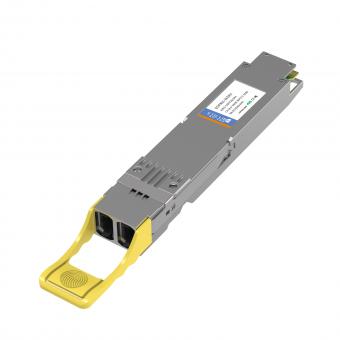
Both QSFP-DD and OSFP, the two mainstream packages, have their limitations. QSFP-DD has high density but high cost and limited power consumption, while OSFP has good heat dissipation but low density and high deployment cost. Downstream customers find it difficult to accommodate both, which exacerbates cost pressures.
If you're having trouble choosing a 400G product , don't worry, ETU-LINK is always here to support you. Feel free to contact us anytime.
III. Industry Chain and Compatibility Challenges: Insufficient Collaboration Hinders Commercial Deployment
The three major technological routes for 400G optical modules—silicon photonics, InP, and TFLN—each have their own advantages and disadvantages, with significant differences in the maturity of the industry chain and insufficient synergy. This technological competition leads to difficulties in downstream selection, and the lack of collaboration between upstream, midstream, and downstream sectors, coupled with inconsistent standard implementation and asynchronous iteration, hinders commercial deployment. In terms of compatibility, although industry standards such as CMIS and OSFP MSA exist, differences in vendor implementations lead to vendor ID verification limitations in selection, potential faults in mixed deployments, and insufficient interface compatibility with downstream equipment, increasing maintenance costs.
IV. Engineering Implementation and Operations & Maintenance Challenges: The Gap Between the Laboratory and the Data Center
Even if 400G optical modules solve the problems of technology, cost, and industrial chain, their large-scale application in data centers still faces two major pain points: deployment and operation and maintenance. In terms of deployment, the requirements for data centers, optical fibers, and equipment are much higher than those for 100G, requiring transformation and upgrades, which increases engineering costs and difficulty. In terms of operation and maintenance, fault location is difficult, vendor interfaces and alarms are not standardized, and components age quickly, which greatly increases operation and maintenance costs and workload.
V. Summary of Challenges and Industry Implications
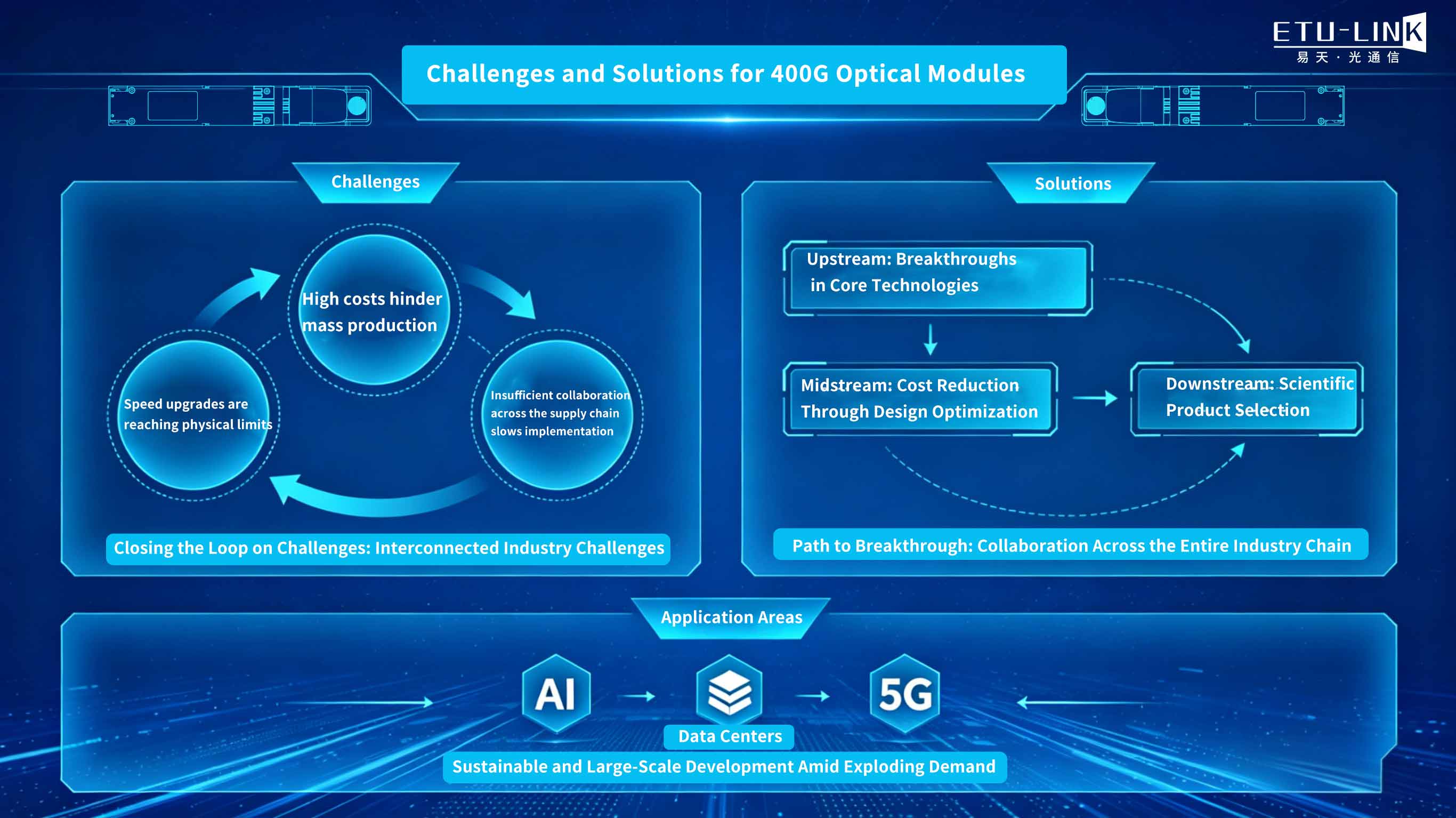
The core pain points of 400G optical modules are that speed upgrades have reached physical limits, high costs hinder large-scale production, and insufficient industry chain collaboration slows down deployment. These three factors are interconnected and form a "pain point loop," which presents both challenges and opportunities for industry professionals. Breakthroughs in core technologies upstream, cost reduction through design optimization in the midstream, and scientific selection downstream, along with collaboration across the entire industry chain, are essential to drive the healthy and large-scale development of 400G optical modules in the context of the explosive growth in demand from AI, data centers, and 5G.
For inquiries about our products or pricelist, please leave your information with us and we will be in touch with in 24 hours.


 13th Floor, Building 6, Honghualing Base, Nanshan Intelligent Manufacturing Base, Liuxian Avenue, Taoyuan Street, Xili, Nanshan District, Shenzhen, China
© Copyright: 2026 ETU-Link Technology CO ., LTD All Rights Reserved.

IPv6 network supported
Friendly Links:
易天官网