English



How to connect the MPO optical module with LC optical module?
In 40G/100G data center cabling, many engineers ask: How to connect MPO optical module to LC optical module? How to connect 40G QSFP+ (MPO) to 10G SFP+ (LC)? What cables and panels are needed?
At present, there are usually two types of optical modules in the market: MPO and LC. For two optical modules with the same interface, MPO patch cord or LC patch cord can basically realize the connection between them.
For the optical modules of different interfaces, In addition to using MPO trunk fiber patch cords and LC duplex fiber patch cords, other fiber-optic cabling products such as fiber optic adapter panels and MPO-LC duplex fiber distribution boxes are required. ETU-link will introduce the solution of QSFP+ optical module and SFP+ optical module connection through this article.
I. How to Connect MPO Module to LC Module Directly?
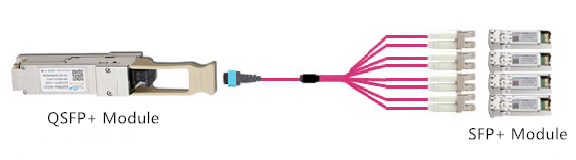
This is the simplest MPO to LC direct connection method, also called breakout connection. It uses one MPO‑LC fanout cable to split 1×MPO into 4×LC duplex, supporting 40G QSFP+ to 4×10G SFP+ interconnection.
II. How to Connect MPO Module to LC Module via Structured Cabling?
▲QSFP+ optical module and SFP+ optical module interconnection solution
①The following figure shows the interconnection of the 40G QSFP+ optical module and the 10G SFP+ optical module. The QSFP+ optical module and the SFP+ optical module on both sides are respectively connected with the MPO trunk fiber patch cord and the LC duplex fiber patch cord. The connection between the MPO trunk fiber patch cord and the LC duplex fiber patch cord, it need to use the fiber adapter panel, the MPO trunk fiber patch cord, and the MPO-LC duplex fiber distribution box.This connection method allows device replacement at both ends of the fiber link. The specific connection method and required fiber optic equipment are shown in the following figure.
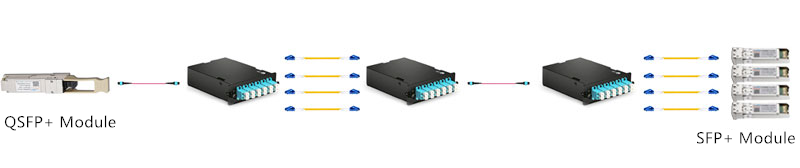
This structured cabling solution uses a distribution box & adapter panel to convert MPO to LC, supporting cross‑cabinet and long‑distance deployment with high flexibility.
②The following figure shows the another interconnection of QSFP+ optical module and SFP+ optical module. This connection solution is different from the previous connection solution in that the SFP+ optical module is a fiber access device at the end. The final step is connect to the SFP+ optical module through the fiber adapter panel and the LC duplex branch fiber patch cord. However, since the SFP+ optical module ports must be on the same chassis, the disadvantage of this method is the lack of flexibility of the SFP+ optical module. In other words, the connection solution does not allow replacement of optical fiber access devices at the end of SFP+ optical module.
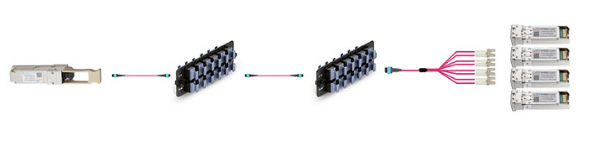
This is a fixed‑end connection method. The LC side is centralized on one device, which is simple but less flexible for later expansion.
III. How to Realize Cross-Connection Between MPO and LC Modules?
▲ QSFP+ optical module and SFP+ optical module cross-connect solution
The following two methods can realize the cross-connection between QSFP+ optical module and SFP+ optical module.The main differences are shown in the following two figures: QSFP+ optical module side.The first cross-connection solution is mainly completed through MPO main fiber patch cord, MPO-LC duplex fiber distribution box and LC duplex fiber patch cord.
The second cross-connection solution is more complex and requires the use of fiber adapter panels in addition to the optical fiber equipment.This cross-linking method is more suitable for applications with longer distances between distribution ranges, where it is necessary to ensure that the trunk optical cable of the splice tray is protected from damage.
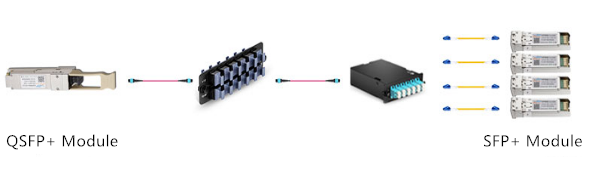
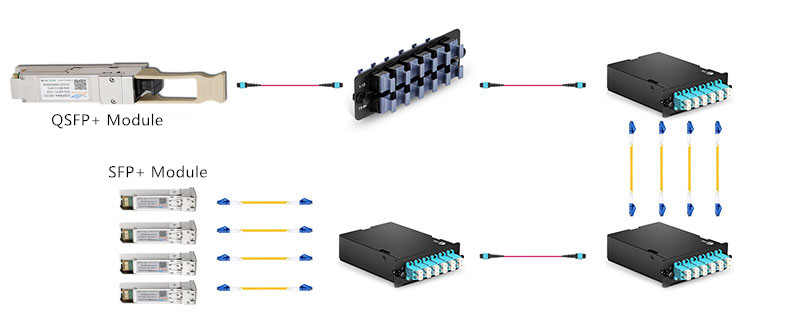
Cross‑connection solutions are suitable for large‑scale data centers with complex cabling, long distances, and high‑reliability requirements. They use centralized distribution to facilitate O&M and management.
Through this article, you can know how to interconnect the MPO interface optical module and the LC interface optical module. For more details, welcome to visit our website (etulinktechnology.com), thank you for your support!
Connecting MPO optical modules to LC optical modules can be done via direct breakout cable, structured cabling with distribution box, or cross‑connection solution. Choose based on distance, cabinet layout, and flexibility needs.
ETU-LINK provides MPO‑LC patch cords, MPO modules, LC modules, and distribution boxes for stable 40G/100G to 10G/25G interconnection in data centers.
For more details, welcome to visit our website (etulinktechnology.com), thank you for your support!
FAQ: Common Questions About MPO to LC Connection
1.What is an MPO optical module?
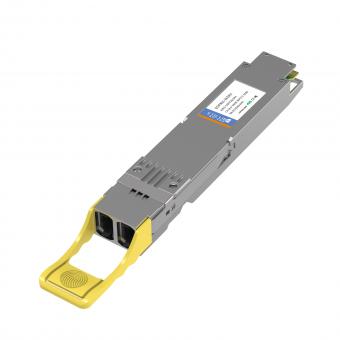
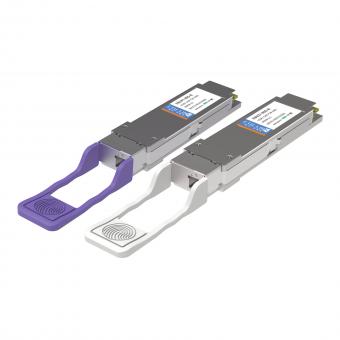
MPO optical modules are multi‑core fiber modules, mostly used in 40G QSFP+ SR4 (8‑core MPO) and 100G QSFP28 SR4 (12‑core MPO).
2.What is an LC optical module?
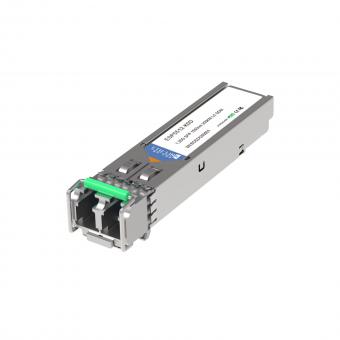
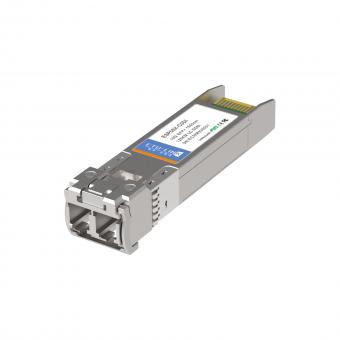
LC optical modules are duplex single‑core modules, widely used in 1G SFP, 10G SFP+, 25G SFP28.
3.What cable is used to connect MPO to LC?
MPO to 4×LC duplex breakout patch cord (fanout cable), 8‑core for 40G, 12‑core for 100G.
4.Can MPO and LC be connected directly?
Yes, using an MPO‑LC breakout cable. For structured cabling, use a distribution box + adapter panel.
5.What is the difference between MPO trunk and MPO‑LC breakout?
MPO trunk is used for long‑distance backbone transmission; MPO‑LC breakout is used for converting to LC ports at the access layer.
Last updated: May 19, 2026
Categories
New Blog
Tags
For inquiries about our products or pricelist, please leave your information with us and we will be in touch with in 24 hours.


 13th Floor, Building 6, Honghualing Base, Nanshan Intelligent Manufacturing Base, Liuxian Avenue, Taoyuan Street, Xili, Nanshan District, Shenzhen, China
© Copyright: 2026 ETU-Link Technology CO ., LTD All Rights Reserved.

IPv6 network supported
Friendly Links:
易天官网