English




Latest Market Updates on 800G Optical Modules
Looking at high-speed optical interconnects from the front lines of the industry, AI computing architecture is reshaping the demand curve for optical modules. Recent industry growth expectations have been continuously revised upwards, with 800G currently in a golden window for large-scale delivery, while the next-generation 1.6T is rapidly approaching. Leaving aside research report rhetoric, we'll discuss the real 800G market from the perspectives of supply and demand, industry chain structure, and iteration pace, based on the latest industry forecast data.
Those working in optical communication or AI hardware should have noticed a significant change this year: the growth in demand for optical modules is no longer simply a matter of "the number of AI servers increasing."
In the past, when estimating the demand for optical modules, people were accustomed to equipping a server with a certain number of optical ports. However, with the widespread adoption of rack-mount architectures and a significant increase in interconnect density between GPU, the number of optical modules required for a single computing power unit is continuously rising. This is the core underlying reason why the market potential for high-speed optical modules has been continuously revised upwards.
Ⅰ.Perspectives from the Industry Demand Curve
Based on the latest industry estimates:
$67.7 billion in 2026, $131.4 billion in 2027, and $148.5 billion in 2028. Compared to previous baseline forecasts, the upward revisions for the three years represent increases of 33%, 81%, and 115% respectively, with 2027 showing the largest upward revision.
Global optical module shipments: 548 million units in 2026, 691 million units in 2027, and 729 million units in 2028, representing upward revisions of 21%, 31%, and 31% respectively compared to the previous forecast.
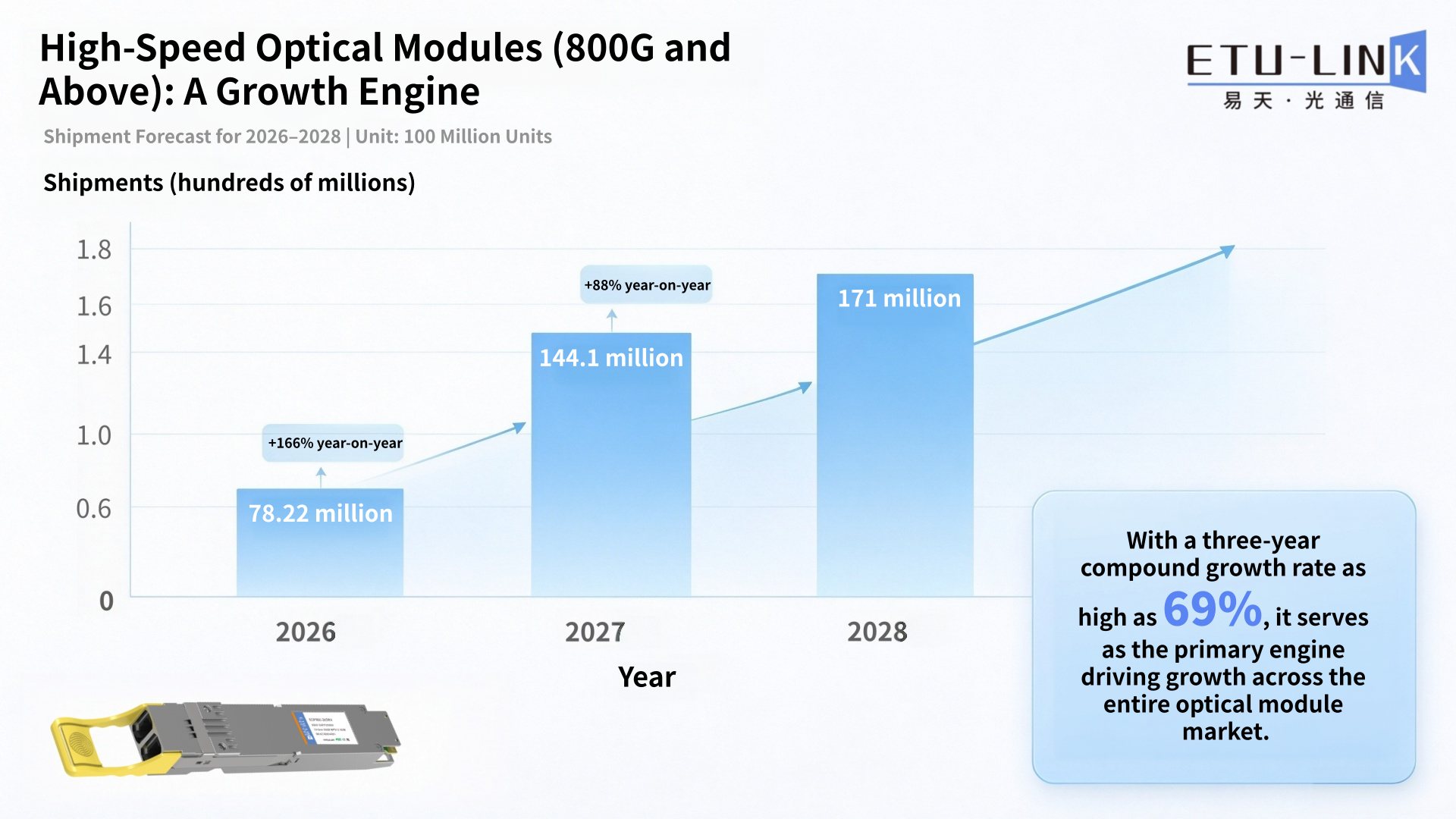
High-speed optical modules of 800G and above:
2026: Shipments are projected to reach 78.22 million units, representing a year-over-year increase of 166%;
2027: Shipments are projected to reach 144 million units, continuing to grow by 84% year-over-year;
2028: Shipments are projected to reach 171 million units.
With a compound annual growth rate (CAGR) of 69% from 2026 to 2028, this segment will be the primary driver of growth for the entire optical module market.
Many people have a misconception: Now that the 1.6T is here, will the 800G be phased out soon?
Judging from frontline orders and customer planning, the answer is no.
The 1.6T model is in the new product introduction phase, and chip verification, reliability testing, production line ramp-up, and large-scale customer replacement all require time. In 2026 and 2027, 800G will remain the preferred main model for expanding global AI computing power clusters. In the capital expenditure plans of leading overseas computing power manufacturers, 800G procurement orders are already scheduled beyond 2027.
The 800G market is currently in a state of tight balance: downstream demand is strong, but capacity release is constrained by upstream components, meaning that expanding production cannot be achieved immediately. Leading manufacturers prioritize securing upstream core component capacity and prioritizing orders from major customers; while second-tier manufacturers are also expanding production, their shipment flexibility is limited by the supply constraints of optical chips and DSP, and industry differentiation will continue to intensify.
Structurally, the proportion of data communication optical modules (used in AI data centers) in the overall optical module market is rapidly increasing. It is estimated that the proportion of data communication optical modules will exceed 60% in 2026; by 2028, the proportion of high-speed data communication products is expected to approach 75%, while the proportion of telecom-side optical modules continues to shrink, and the industry focus has completely shifted to AI computing power networks.
Ⅱ.The Industry Chain Landscape
In the high-speed optical data communication module market, domestic manufacturers have already gained global dominance.
In the global data communication optical module market, domestic manufacturers account for more than 60% of the total market share.
In the 800G high-end product market, the combined market share of leading domestic manufacturers has further increased to over 70%, and their product verification, yield, and delivery capabilities have been validated by major overseas customers over a long period of time.
However, the competitive logic has changed: in the early days, the competition was about who could produce samples first and who could pass customer certification first; now, the competition is about stable delivery capabilities, supply chain material securing capabilities, cost control, and the comprehensive strength to develop the next generation of products simultaneously.
On one hand, factories are continuously ramping up their 800G production capacity to ensure the delivery of existing orders; on the other hand, all leading manufacturers are simultaneously advancing the sampling, verification, and small-batch trial production of 1.6T products. This is a two-pronged battle: maintaining the current performance base brought by 800G while not falling behind in the next generation of high-speed products.
In terms of pricing, the market had previously worried that 800G would experience rapid price drops and squeeze profits. However, current industry feedback indicates that tight supply of core components will support price resilience, and price reductions over the next two years are likely to remain in the single digits, without a precipitous price collapse. Leading companies, relying on long-term contracts to secure supplies, will have significantly better profit stability than smaller manufacturers. In contrast, during the later stages of the 400G iteration, annual price drops exceeded 20%, demonstrating the significantly more stable price cycle of 800G.
Ⅲ.Industry Evolution
The biggest incremental change in the market is that the pace of high-speed product iteration is faster than predicted last year. The shipment forecast for 1.6T has been significantly revised upward, which means that the upgrade cycle of computing power networks has been brought forward. The industry is now in a typical period of two generations of products running in parallel: 800G is being used on a large scale, and 1.6T is beginning to be introduced.
According to industry estimates, the shipment volume of 1.6T optical modules in 2026 was still in the tens of millions of units, mainly for customer pilot projects and small-scale cluster deployments; shipments will see a jump from 2027, with the shipment volume of 1.6T expected to exceed 40 million units in 2027 and approach 90 million units in 2028.
The two are not simply substitutes for each other, but rather deployed in a tiered manner. Some newly built ultra-large computing clusters will directly pilot the 1.6T version; while the vast majority of expansion projects will continue to procure the mature and stable 800G version. It is expected that by the end of 2028, the shipment share of 800G and 1.6T in the high-speed optical module market will be roughly 50/50, and the two generations of products will coexist for a long time to come.
In the long run, the 3.2T technology route has also entered the pre-research stage. The technological iteration of high-speed optical interconnect will not stop, and the demand for computing power and network bandwidth will continue to rise.
Ⅳ.Major Risks That Cannot Be Overlooked at the Industry Level
Despite the improved economic climate, the industry still faces real constraints, and we cannot rely solely on optimistic expectations.
1.Upstream core components remain the biggest bottleneck: the shortage of high-speed lasers and DSP chips directly determines the upper limit of shipments for optical module manufacturers. Industry estimates suggest that the supply of high-speed optical chips can only meet about 75% of the theoretical capacity demand for 800G. Even if module manufacturers' production lines are ready, chip shortages will still hinder delivery.
2.Policy risks in overseas supply chains: Domestic manufacturers have a high proportion of overseas revenue, with leading companies generally having more than 60% of their revenue coming from overseas. Changes in the external policy environment will directly affect customer delivery and order fulfillment.
3.Fluctuations in Customer Capital Expenditure: The pace of capital expenditure by overseas cloud vendors and AI companies is uncertain. If the growth rate of computing power capital expenditure falls by 10%-15%, the corresponding new demand for high-speed optical modules will shrink significantly.
4.Risks associated with technological evolution: If the next generation of products is launched faster than expected, it will shorten the product life cycle of 800G and bring price pressure. If the penetration rate of 1.6T reaches 40% one year ahead of schedule, the price reduction of 800G will accelerate significantly.
Concluding Remarks
Our observation of the entire optical module industry reveals a significant shift: the demand for optical interconnects driven by AI computing power has entered a new paradigm. It's no longer simply growing linearly with the number of servers, but rather experiencing a multiplier effect in demand brought about by innovations in computing architecture. Under traditional architectures, a single AI server is equipped with approximately four optical modules; however, under the new rack-mount architecture, the number of optical modules per server has increased to 8-12. This multiplier effect is the underlying logic behind the continued upward revision of the high-speed optical module market.
800G stands at the forefront of the industry's explosive growth, serving as a cornerstone for the industry chain's performance over the next two years; while 1.6T follows closely behind, opening up medium- to long-term growth potential. Future industry dividends will continue to concentrate on leading companies with strong supply chain control, stable delivery, and continuous R&D iteration capabilities.
High industry prosperity does not mean no fluctuations. Demand forecasts are based on projections of current computing power plans, but actual implementation will be affected by multiple variables such as supply chain and capital expenditure. Industry professionals need to view growth expectations rationally.
That concludes this article! Please like and save this post to stay updated on the latest industry developments in computing hardware upgrades, domestic substitution, and technological shifts. Follow us for authoritative policy interpretations and in-depth industry analysis.
For inquiries about our products or pricelist, please leave your information with us and we will be in touch with in 24 hours.


 13th Floor, Building 6, Honghualing Base, Nanshan Intelligent Manufacturing Base, Liuxian Avenue, Taoyuan Street, Xili, Nanshan District, Shenzhen, China
© Copyright: 2026 ETU-Link Technology CO ., LTD All Rights Reserved.

IPv6 network supported
Friendly Links:
易天官网