English



The difference between multimode fiber OM3-150 and OM3-300
In data center 10G/40G/100G multimode cabling, OM3 fiber is the most widely used laser‑optimized multimode type. Many users ask: What are OM3‑150 and OM3‑300? What is the difference between OM3‑150 vs OM3‑300? Which one should I choose for my data center? This article will explain their definition, bandwidth, transmission distance, optical characteristics, and application scenarios in detail to help you make the best cabling choice.
The OM3 patch cord is a 10-Gigabit multi-mode patch cord. The multi-mode fiber uses light-emitting diodes as the light source, allowing multiple beams of light to propagate in the fiber at the same time, thereby forming a mode dispersion. Mode dispersion technology limits the bandwidth and distance of multimode fiber. Therefore, the core wire of multimode fiber is thick, the transmission speed is low, the distance is short, and the overall transmission performance is poor, but its cost is relatively low. It is generally used in buildings or geographical areas. Location adjacent to the environment.
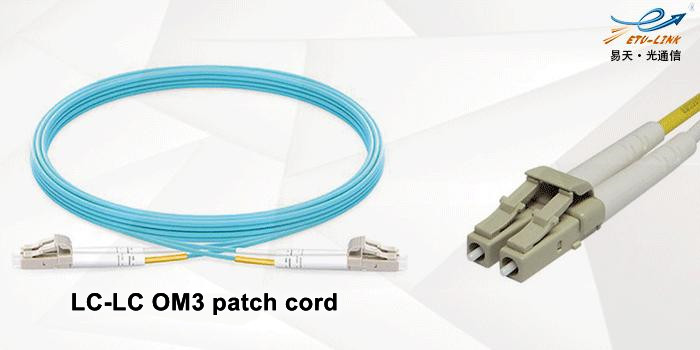
OM3 fiber is a laser-optimized fiber type, which can provide a higher transmission bandwidth in a transmission window of 850nm. In a Gigabit network, OM3 can support a transmission distance of 550 meters, and in a 10 Gigabit Ethernet, OM3 can transmit up to 300 meters. In 40G/100G Ethernet, OM3 can be transmitted up to 100 meters.
OM3 fiber is designed for VCSEL laser light sources, which supports high‑speed 10G/40G/100G Ethernet transmission and is the standard multimode fiber for modern data centers, enterprise rooms, and campus backbones.
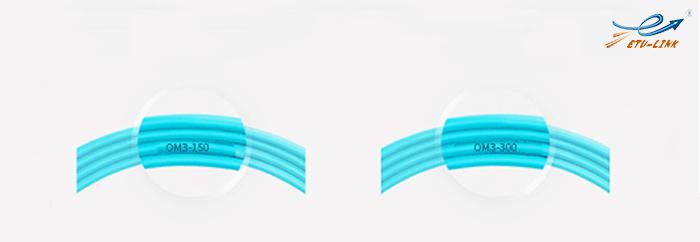
The bandwidth of multi-mode fiber is 50MHz~500MHz/Km. OM3 can be divided into two series, namely OM3-150 and OM3-300.
II. What Is the Difference Between OM3‑150 and OM3‑300?
OM3-150 refers to the longest transmission distance of this patch cord type in 10 Gigabit Ethernet. 150 meters, OM3-300 refers to the maximum transmission distance of this patch cord type in 10 Gigabit Ethernet is 300 meters. In addition to the difference in transmission distance, the effective bandwidth of the two is also different. The effective bandwidth of OM3-300 is higher than that of OM3-150.
The core difference lies in effective bandwidth and 10G transmission distance. OM3‑300 has more than double the effective bandwidth and supports double the transmission distance of OM3‑150.
|
Optical Characteristics |
Wavelength |
OM3/150 |
OM3/300 |
|
Attenuation |
850nm |
≤2.3dB/km |
≤2.3dB/km |
|
1300nm |
≤0.8dB/km |
≤0.8dB/km |
|
|
Full injection bandwidth |
850nm |
≥700MHz·km |
≥1500MHz·km |
|
1300nm |
≥500MHz·km |
≥500MHz·km |
|
|
Effective bandwidth |
850nm |
≥950MHz·km |
≥2000MHz·km |
|
10 Gigabit transmission longest link |
|
≤150m |
≤300m |
III. Why Are OM3 Fibers Used with VCSEL Light Sources?
The high bandwidth of OM3 10G multimode optical cable at 850nm is designed to adapt to VCSEL laser light sources. VCSEL lasers are cheaper than traditional lasers, have better performance than LED light sources, and can be used in 10GB Ethernet transmission.
VCSEL lasers feature low power consumption, high speed, and low cost, perfectly matching OM3 fiber. Together they form the most cost‑effective high‑speed multimode transmission solution for data centers.
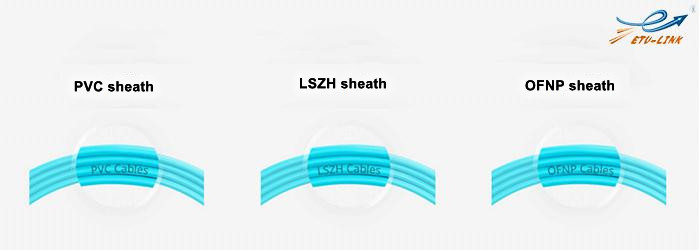
The OM3 patch cord is aqua blue, and its outer sheath material can be divided into PVC sheath, LSZH sheath, OFNP sheath.
1. PVC sheath is very soft, anti-oxidation, suitable for horizontal and vertical applications in ventilated buildings;
2. LSZH The sheath is low and halogen-free, suitable for horizontal structure wiring areas and data center computer rooms;
3. OFNP sheath has the highest fire rating and is suitable for vertical operation between data center floors.
Aqua blue is the international standard color for OM3 fiber, making identification and maintenance easier. Different sheath materials adapt to commercial, industrial, and fire‑safety‑required environments.
Ⅴ. What Are the Advantages of ETU‑LINK OM3 Multimode Fiber?
The OM3 10 Gigabit multi-mode optical cable of ETU-LINK adopts flame retardant sheath, which can prevent flame spread, smoke, acid gas and poison gas emission, and meet the transmission rate of 10Gb/s. It is usually used in the wiring environment of data center, and supports the transmission of 10G or even 40/100G high-speed Ethernet. ETU‑LINK OM3 patch cords comply with IEC and TIA standards, support 10G/40G/100G rates, and are widely used in data center interconnection, server‑switch links, SAN storage networks, and enterprise campus backbones.
FAQ: Frequently Asked Questions About OM3‑150 vs OM3‑300
1. What does 150/300 mean in OM3‑150 and OM3‑300?
They represent the maximum supported transmission distance (in meters) for 10 Gigabit Ethernet at 850nm. OM3‑150: up to 150m; OM3‑300: up to 300m.
2. Which is better: OM3‑150 or OM3‑300?
OM3‑300 has higher effective bandwidth and longer transmission distance, better for future‑proofing. OM3‑150 is more cost‑effective for short links within 150m.
3. Can OM3‑150 and OM3‑300 be used together?
Yes. They are both OM3 standard and compatible. The link distance will be limited by the shorter one (OM3‑150).
4. What is the color of OM3 fiber patch cord?
OM3 fiber is standard aqua blue for easy identification in data centers.
5. Can OM3 support 40G and 100G Ethernet?
Yes. OM3 supports 40G up to 100m and 100G up to 70m, suitable for short‑reach data center transmission.
Last updated: May 15, 2026
Categories
New Blog
Tags
For inquiries about our products or pricelist, please leave your information with us and we will be in touch with in 24 hours.


 Factory: Right Side Of 3rd Floor, No. 102 Building, Longguan Expressway, Dalang Street, Longhua District, Shenzhen
Office: Floor 4, Building 4, Nanshan Yungu Phase ll, Taoyuan Community, XiliStreet,Nanshan District, Shenzhen
© Copyright: 2026 ETU-Link Technology CO ., LTD All Rights Reserved.

IPv6 network supported
Friendly Links:
易天官网