English




What is the difference between a built-in power supply and an external power supply fiber optic media converter
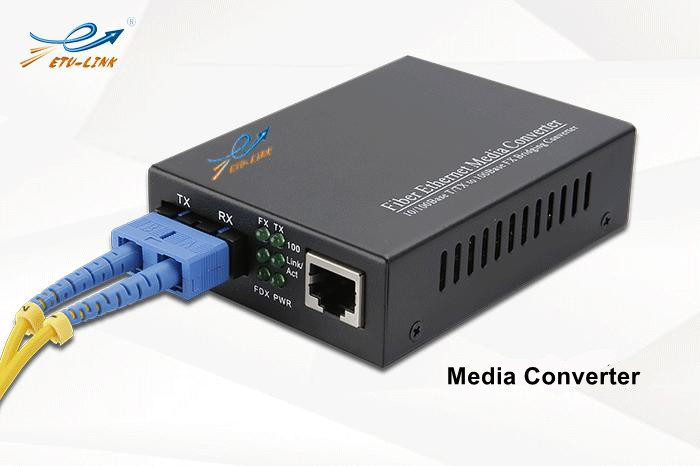
In this article, ETU-LINK will introduce the differences between internal power supply and external power supply optical fiber media converter, as well as their advantages and disadvantages and applications. optical fiber media converter is a kind of Ethernet transmission media conversion unit which can exchange short-distance twisted pair electrical signal and long-distance optical signal. It is also called photoelectric converter in many places.
The products are generally used in the actual network environment where the Ethernet cable cannot cover and the optical fiber must be used to extend the transmission distance, and are usually located in the access layer application of broadband man, such as the high-definition video image transmission of monitoring security engineering.
Ⅰ. What Are Built‑in‑Power And External‑Power Media Converters?
The main difference between the built-in power supply optical fiber media converter and the external power supply optical fiber media converter is the power supply mode, but the actual use effect is the same. In addition, the board settings are different, but the same function can be achieved. The external power supply optical fiber media converter is equipped with a power adapter, and the built-in power supply optical fiber media converter is designed with the power supply inside and can be used after connecting the power cord. The built-in power optical fiber media converter is also divided into two types: plug-in type and non-plug-in card.
Ⅱ. Pros And Cons Of External‑Power‑Supply Fiber Media Converter
The advantage of the external power supply is that the transformer part of the power supply is separated from the main body, and the maintenance cost is low when the equipment has problems, but the actual use of the equipment separation is not very convenient.
External‑Power‑Supply Fiber Media Converter Advantages:
1. Easy maintenance: When power failure occurs, only replace the defective external adapter without changing main converter hardware;
2. Lower unit cost, widely adopted for small‑scale surveillance monitoring projects;
3. Small‑size main unit, flexible for installation inside narrow weak‑current boxes.
External‑Power‑Supply Fiber Media Converter Disadvantages:
1. Extra adapter and power cords create messy cabling; adapters are easy to lose or mismatched on‑site;
2. Poor stability risk: Non‑certified third‑party adapters may cause voltage drift, reboot or random packet‑loss;
3. Occupies extra wall socket space in large‑quantity deployment scenarios.
Typical usage: Small‑and‑medium‑scale IP camera monitoring, temporary network transformation projects, scattered point‑to‑point fiber extension.
Ⅲ. Pros And Cons Of Built‑in‑Power‑Supply Fiber Media Converter
The built-in power supply of the optical fiber media converter with built-in power is a carrier-grade power supply, while the external transformer power supply of the optical fiber media converter with an external power supply is mostly used in civilian equipment. The built-in power optical fiber media converter can be applied to industries such as telecommunications, electric power, broadcasting and television, transportation, industry, medical treatment, education, aerospace and computer, and broadband access.
Built‑in‑Power‑Supply Fiber Media Converter Advantages:
1. No separate power adapter required, neat wiring inside telecom equipment rooms;
2. Carrier‑grade built‑in power circuit, better anti‑surge and anti‑interference performance, suitable for 24‑hour non‑stop operation;
3. Rack‑mount plug‑in card version supports centralized power redundancy via chassis power‑supply module.
Built‑in‑Power‑Supply Fiber Media Converter Disadvantages:
1. Higher product purchase cost than external‑power models;
2. If internal power circuit fails, the whole converter unit needs repair or replacement, maintenance workload increases;
3. The integrated power unit generates extra heat, requiring good ventilation space during cabinet installation.
Typical usage: Telecom broadband MAN access, power‑utility communication system, radio‑and‑television transmission, enterprise machine‑room centralized deployment.
The above is the difference between the built-in optical media converter and the external optical media converter introduced by ETU-LINK.
Last updated: Sept. 24 2026
For inquiries about our products or pricelist, please leave your information with us and we will be in touch with in 24 hours.


 13th Floor, Building 6, Honghualing Base, Nanshan Intelligent Manufacturing Base, Liuxian Avenue, Taoyuan Street, Xili, Nanshan District, Shenzhen, China
© Copyright: 2026 ETU-Link Technology CO ., LTD All Rights Reserved.

IPv6 network supported
Friendly Links:
易天官网