English



Differences Between SFP and BiDi SFP
When selecting optical transceivers for your network infrastructure, understanding the difference between a standard SFP module and a BiDi SFP module is crucial for optimizing fiber usage and deployment costs. Both are hot-pluggable fiber optic transceivers, but they operate on fundamentally different principles.
What is a Standard SFP Transceiver?
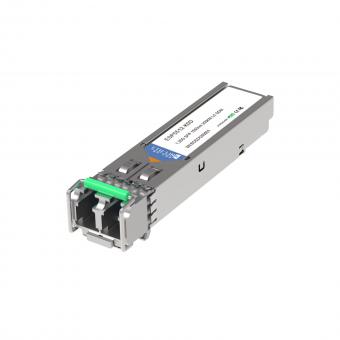
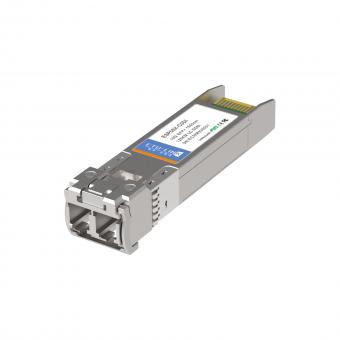
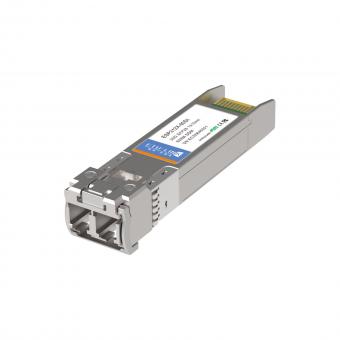
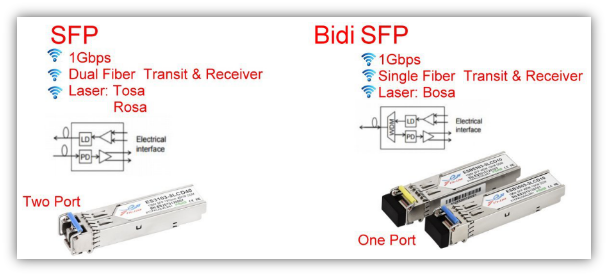
As we learned, a common SFP transceiver is generally with two ports, one is TX port to transmit the signal, and the other one is RX port to receive signals. This means a standard SFP optical module requires two strands of fiber to establish a full-duplex connection—one for transmitting and one for receiving.
What is a BiDi SFP Transceiver?
BiDi SFP transceiver is only with one port which uses an integral WDM coupler to transmit and receive signals over a single strand fiber.BiDi, short for Bidirectional, is a specialized BiDi optical module that leverages Wavelength Division Multiplexing (WDM) technology to combine transmit and receive signals onto a single fiber core, effectively doubling the capacity of existing fiber infrastructure.
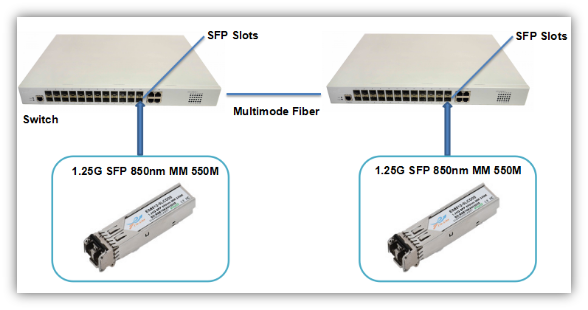
For BiDi SFPs (Single-Fiber):
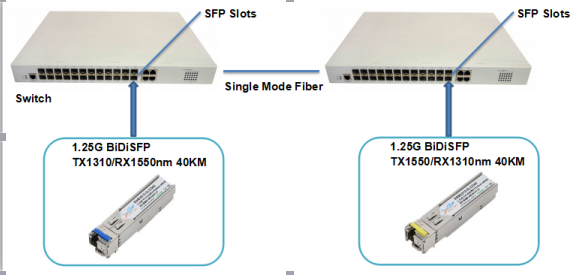
Since BiDi SFP transmits and receives signals with different wavelengths, we should connect the two BiDi SFPs which have the opposite wavelength together. For example, we use a TX1310/RX1550nm BiDi SFP at one end, then we must use a TX1550/RX1310nm BiDi SFP on the other end (shown in the figure below). This single-fiber SFP configuration enables bidirectional communication over one fiber strand.
If you are looking for reliable and cost-effective BiDi SFP, SFP optical modules, or other fiber optic transceiver products, check out ETU-Link's OEM/ODM Optical Transceiver solutions with 100% compatibility guarantee.
Fighting!
Last updated: March 23, 2026
Previous :
The SFP optical transceiverNext :
The difference between CWDM and DWDMCategories
New Blog
Tags
For inquiries about our products or pricelist, please leave your information with us and we will be in touch with in 24 hours.


 Factory: Right Side Of 3rd Floor, No. 102 Building, Longguan Expressway, Dalang Street, Longhua District, Shenzhen
Office: Floor 4, Building 4, Nanshan Yungu Phase ll, Taoyuan Community, XiliStreet,Nanshan District, Shenzhen
© Copyright: 2026 ETU-Link Technology CO ., LTD All Rights Reserved.

IPv6 network supported
Friendly Links:
易天官网