English



How do interconnect a switch 40G QSFP+ port with a 10G SFP+ port?
With the advent of 40G Ethernet, many enterprise users have begun to take full advantage of current 10G network equipment to upgrade to 40G networks. In other words, this involves the use of 40G switches with QSFP+ ports and existing 10G devices (switches and servers) with SFP+ ports. How can I connect a 40G QSFP+ port to a 10G SFP+ port? What solutions are available? Which one is best for my distance and budget?In this article, ETU-LINK will share three common solutions and teach you how to interconnect the switch 40G QSFP+ port and 10G SFP+ port.
Solution 1: How to Use QSFP+ Breakout Cables for 40G to 10G?
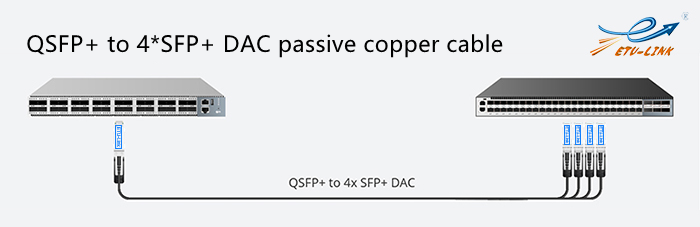
QSFP+ branch cables include QSFP+ to 4*SFP+ DAC passive copper cables, and QSFP+ to 4*SFP+ AOC active optical cables, both of which are connected to a QSFP+ module at the A end and 4 SFP+ modules at the B end, of which the passive copper cable supports a transmission distance of 7m, and the active optical cable supports a transmission distance of 70m. Breakout cables split 1×40G into 4×10G, enabling direct interconnection between QSFP+ and SFP+ ports. They are plug‑and‑play, require no extra modules, and are widely used in top‑of‑rack (ToR) switch connections.
In addition to the above two types of cables, there is a QSFP+ to 4 LC duplex AOC cable. One end of the cable is QSFP+ and the other end is 4 duplex LC optical fiber patch cords, which can be used when 4 SFP+ optical modules are reserved, thus realizing the conversion of QSFP+ to SFP+.
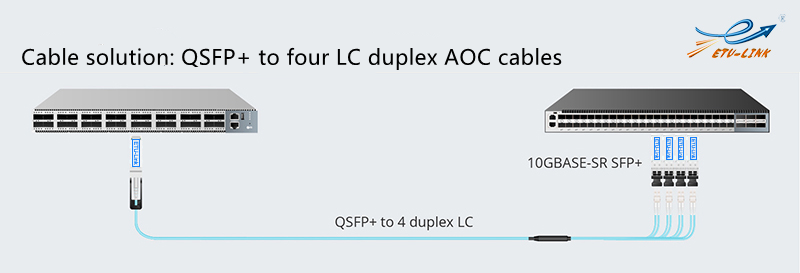
ETU-LINK’s QSFP+ to 4*SFP+ AOC active optical cable has a built-in 4-channel 850nm VCSEL laser array and a PIN photodetector array, which supports digital diagnostic monitoring (DDM). Specifically speaking, it can not only comprehensively analyze the information including the detected temperature, voltage, transmitting and receiving optical power, and warning and alarm status of the laser bias current, so as to predict the fault and locate the fault location, thereby shortening the fault repair time and reducing the loss, but also can predict the life of the laser by monitoring the bias current of the laser.
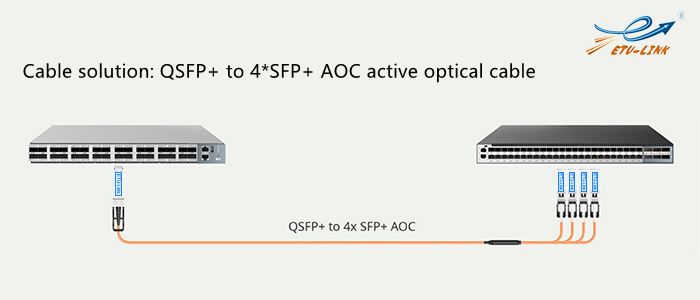
ETU-LINK's QSFP+ to 4*SFP+ DAC passive copper cable has the advantages of anti-radiation interference and lower power consumption. It is the best solution for data transmission within 7m at low cost.
In the 10G upgrade to 40G network solution, you can use a 40G QSFP+ to 4*SFP+ direct connection cable to directly connect to the switch without purchasing additional optical modules, so that it can help you save network costs and simplify the connection process. However, the transmission distance of this connection is limited. Therefore, the DAC or AOC direct-connect optical cable is more suitable for the connection of the switch inside the cabinet or the switch between two adjacent cabinets.
Typical applications:
DAC: cabinet‑internal short links ≤7m
AOC: adjacent cabinets ≤70m
Low cost, high reliability, zero configuration
Solution 2: How to Use MPO to LC Patch Cords for 40G to 10G?
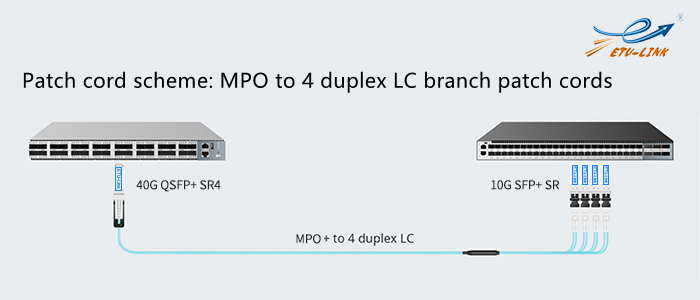
Patch cord scheme: use MPO to transfer 4 duplex LC branch patch cords
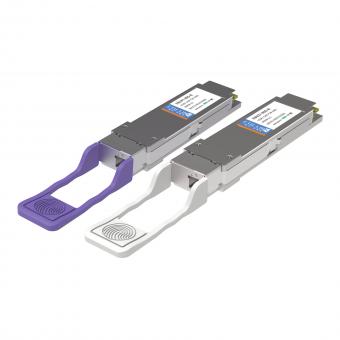
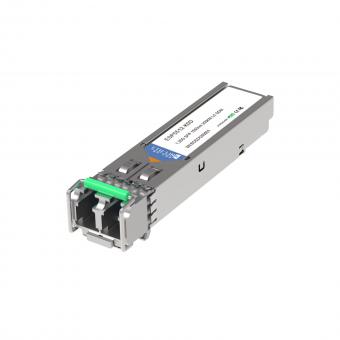
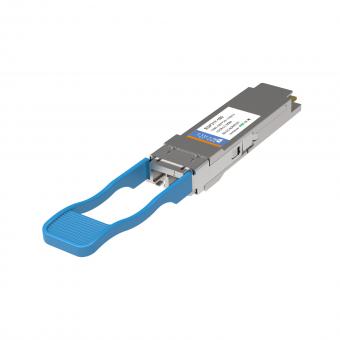
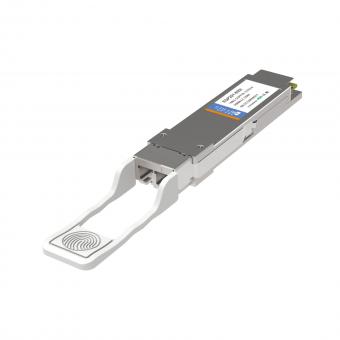
The MPO to LC branch patch cord is an OM3 or OM4 multi-mode optical fiber that connects the MPO connector with 8/12 cores at the A end and 4 duplex LC connectors at the B end. When using the MPO to LC branch patch cord scheme, one 40G QSFP+ SR4 optical module and four 10G SFP+ SR optical modules need to be reserved at both ends of the switch. When using, we just insert the MPO connector into the 40G QSFP+ SR4 optical module interface, and then insert the 4 duplex LC connectors into the 4 10G SFP+ SR optical module interfaces.
This method uses standard optical modules and structured cabling. It supports transmission distances up to 100m (OM3/OM4), making it ideal for cross-cabinet and structured data center cabling.
Required devices:
40G side: QSFP+ 40G SR4 module + MPO‑LC trunk cable
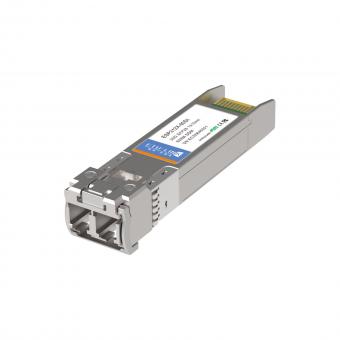
10G side: 4× SFP+ 10G SR modules
Supports 4‑channel 10G transmission
Solution 3: How to Use QSFP+ to SFP+ Converter Module?
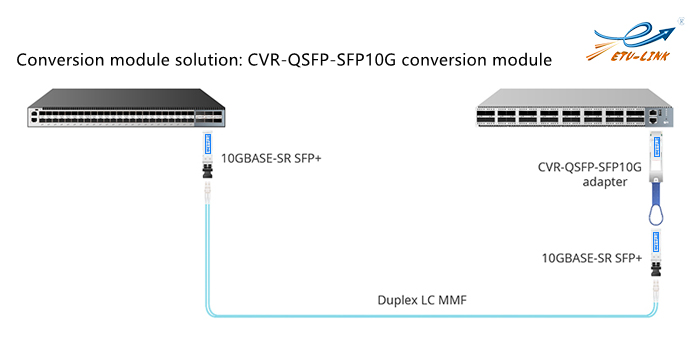
Conversion module solution: CVR-QSFP-SFP10G conversion module
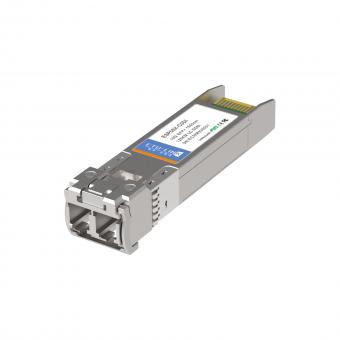
The solution is to convert 40G ports on the switch to 10G ports through the 40G QSFP+ to 10G SFP+ converter module CVR-QSFP-SFP10G, so as to realize the interconnection of QSFP+ ports and 10G SFP+ ports. The operation method is to insert the 40G converter CVR-QSFP-SFP10G into the QSFP+ port, and then insert the 10G SFP+ optical module. By doing this, you can replace the 40G port with a 10G port
The converter module (adapter) allows one 40G port to run as one 10G port, instead of 4‑lane breakout. It is ideal if you only need a single 10G link from a 40G port.
Features:
Physical adapter: QSFP+ housing → SFP+ slot
Supports any 10G SFP+ module (SR, LR, ER, etc.)
Simple configuration, widely compatible with major switches
Which 40G to 10G Solution Should You Choose?
In actual data centers or other high-density cabling applications, network upgrades are a complicated process, and sometimes cross-connections can be considered, but the specific method requires comprehensive consideration of transmission distance, transmission media, network density, and cost factors.
Therefore, within the transmission distance of 7m, ETU-LINK recommends that you can choose QSFP+ to 4*SFP+ DAC passive copper cable, which is the most cost-effective in the short-distance transmission scheme; within the transmission distance of 70m, it is recommended that you choose QSFP+ to 4*SFP+ AOC active optical cable. Within the transmission distance of 100m, it is recommended that you choose MPO to 4 duplex LC branch patch cords to connect the 40G SR4 optical modules and 10G SR optical modules at both ends.
Quick selection guide:
≤7m: QSFP+ to 4×SFP+ DAC (lowest cost)
≤70m: QSFP+ to 4×SFP+ AOC (long reach, low power)
≤100m (structured cabling): MPO‑LC + SR4 + 4×SR
Single 10G from 40G port: CVR-QSFP-SFP10G converter
FAQ: Frequently Asked Questions About 40G QSFP+ to 10G SFP+
1.Can a 40G QSFP+ port connect directly to a 10G SFP+ port?
No, you need a breakout cable, MPO‑LC solution, or converter module. Direct connection is not supported.
2.Can I use a 40G SR4 module with 10G SFP+?
Yes, with an MPO‑to‑4×LC breakout patch cord. The 40G SR4 splits into four 10G SR channels.
3.What is the difference between DAC and AOC breakout cables?
DAC is passive copper, ≤7m, low cost. AOC is active optical, ≤70m, longer distance.
4.Does the converter module support all 10G SFP+ modules?
Yes, the CVR‑QSFP‑SFP10G converter supports standard 10G SFP+ modules (SR, LR, LRM, ER, etc.).
5.Do I need to configure the switch for 40G–10G interconnection?
Most switches support plug‑and‑play, but some require enabling breakout mode on the 40G port.
Conclusion
Connecting 40G QSFP+ to 10G SFP+ can be easily achieved using breakout cables, MPO‑LC patch cords, or converter modules. Each solution fits different distances, costs, and cabling environments. With the right method, you can smoothly upgrade your network while reusing existing 10G equipment.
ETU-LINK provides full series 40G QSFP+ modules, 10G SFP+ modules, DAC/AOC breakout cables, MPO‑LC patch cords, and QSFP+ to SFP+ converters for stable data center interconnection.
Last updated: May 15, 2026
For inquiries about our products or pricelist, please leave your information with us and we will be in touch with in 24 hours.


 13th Floor, Building 6, Honghualing Base, Nanshan Intelligent Manufacturing Base, Liuxian Avenue, Taoyuan Street, Xili, Nanshan District, Shenzhen, China
© Copyright: 2026 ETU-Link Technology CO ., LTD All Rights Reserved.

IPv6 network supported
Friendly Links:
易天官网