English



800G OSFP Package Comparison: RHS vs. IHS
With the large-scale deployment of 800G AI computing clusters, many buyers only focus on optical parameters such as SR8/DR8/FR4 during procurement, neglecting the differences between IHS and RHS packaging. This leads to problems such as modules not fitting into the cage, insufficient heat dissipation, and project delays. This article thoroughly explains the differences between the two mainstream OSFP thermal packages, compatible modules, selection solutions, and key points to avoid pitfalls.
I. Introduction to Basic Concepts
As the mainstream package for 800G and next-generation 1.6T optical modules, OSFP defines two completely different heat dissipation architectures according to the OSFP MSA protocol: IHS integrated fin heat dissipation and RHS flat-top heat dissipation.
A very crucial point to understand: Optical Parameters ≠ Package Type.
The same 800G OSFP SR8, DR8, and 2×DR4 optical modules have completely identical optical signal, transmission distance, and fiber parameters. The casing can be made into either an IHS finned version or an RHS flat-top version. The core differences between the two are the heat dissipation solution, mechanical dimensions, cage compatibility, and power supply platform.
1.OSFP --IHS (Integrated Heat Sink)
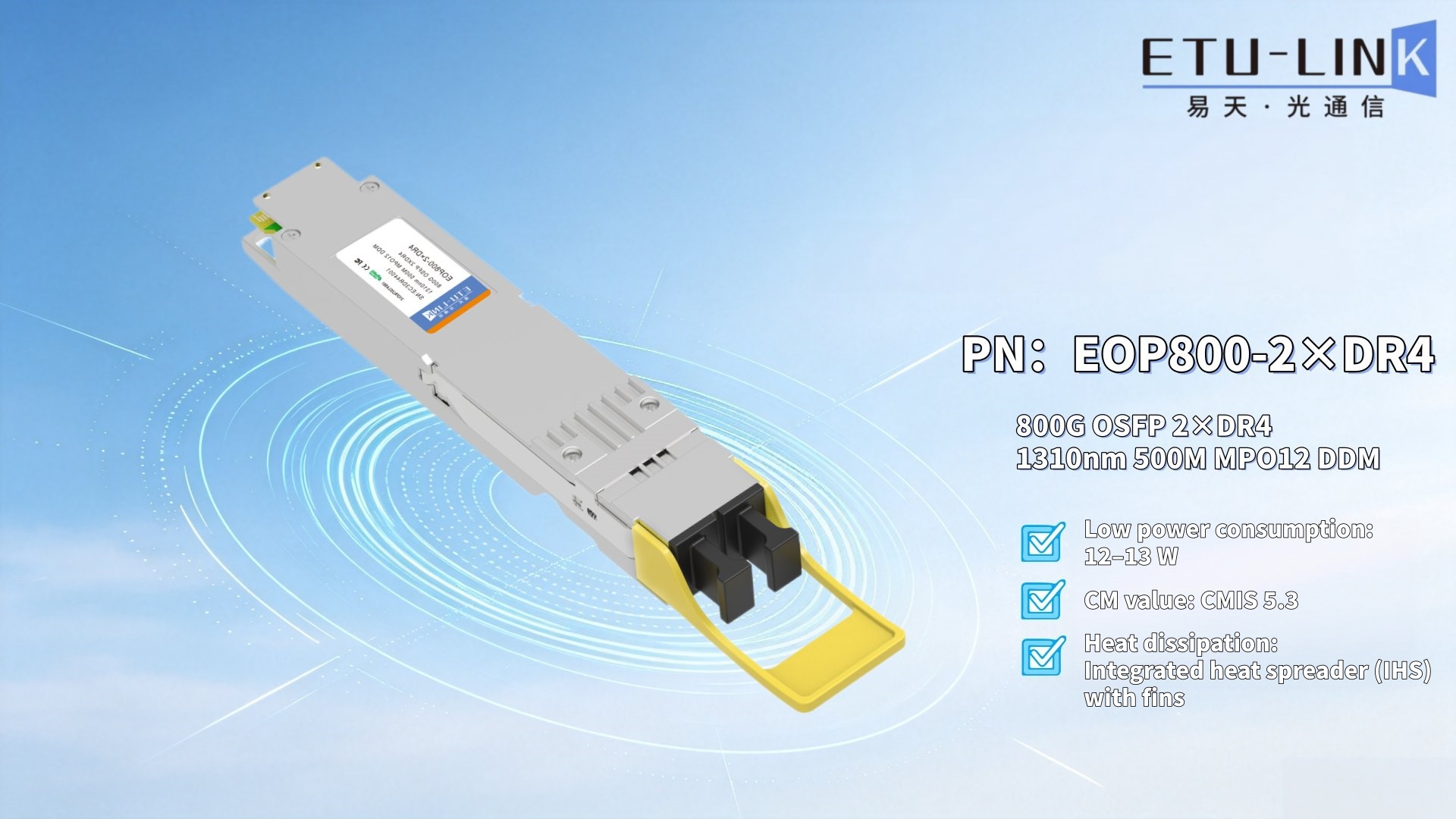
Commonly known as the standard OSFP with fins. The module itself has built-in metal heat sink fins , which rely on the convection of cool air flowing from the front and back of the chassis for heat dissipation. It is the default solution for Ethernet switches and traditional air-cooled server rooms.
(1)Total module height: 13mm (including fins)
(2)Power supply specifications: mainstream 3.3V power supply
(3)Cooling method: Air-cooled convection cooling
(4)Maximum power consumption: Air-cooled scenario ≈ 30-33W
2.OSFP --RHS (RidingHeatSink, flat top)
Commonly known as Flat Top OSFP. The top surface of the module is smooth and finless. Heat dissipation is handled by the heat sink/cold plate pre-installed on the host cage, which presses the top surface of the module together and dissipates heat through the contact heat exchanger. It is the preferred solution for current AI servers and liquid cooling clusters.
(1)Module body height: 9.5mm (without fins)
(2)Power supply specifications: 3.3V for low-power version;
(3)Heat dissipation method: pressure contact heat conduction (cold plate/liquid cooling)
(4)High heat dissipation potential, compatible with ultra-high power consumption modules
Important Red Line: IHS and RHS cages are physically incompatible!
The IHS module cannot be inserted into the RHS cage, and the RHS module cannot be inserted into the IHS cage; although their electrical signal pin definitions are compatible, their housing heights are different, and forcibly inserting or removing them can easily damage the cage and the module. This is also the most common pitfall in project procurement.
II. Comparison Table of Core Parameters
Comparison Dimensions
OSFP--IHS
(Fin Top)
OSFP--RHS
(Flat Top)
Top Appearance
Protruding metal heat sink fins
Smooth surface, no fins
Module height
13mm
9.5mm
Heat dissipation responsibility
The module has built-in finned heat dissipation.
The heatsink/cooling plate on the main unit side is responsible for heat dissipation.
Cooling method
Chassis air cooling convection
Compacting heat-conducting material (liquid cooling/cold plate)
Cage type
Standard OSFP cage
RHS-specific cages, do not mix with other cages.
Typical power supply
3.3V
3.3V
Applicable power consumption range
≤30W
High power consumption modules above 30W
Port density
Normally, the fins occupy vertical height.
The taller, lower chassis supports a port stacking layout.
Ecological maturity
Mature, standard configuration for the vast majority of switches
AI-centric customization, primarily focused on server ecosystem
III. Compatibility List: 800G Optical Modules for IHS vs. RHS
Applicable Scenarios
Package Options
(IHS & RHS)
Module Model
Typical Power Consumption
Rack-mounted/ToR (50–100m)
IHS is the main focus.
800G OSFP 2*SR4/SR8
12–16W
Park/Building Backbone ≤ 500m
IHS is the main focus.
800G OSFP 2*DR4/DR8
14–17W
Building interconnection/industrial park ≤2km
IHS is the main focus.
800G OSFP 2*FR4
14–17.5W
City/industrial park backbone ≤10km
IHS is the main focus.
800G OSFP 2*LR4
15–18W
IV. In-Depth Analysis: Pros and Cons of the Two Form Factors
OSFP--IHS (Fin Top)
(1)Advantages
Plug and play, the module has a built-in heat dissipation structure, and the switch does not require an additional heat sink design;
Air-cooled server rooms can be deployed directly without modifying the overall heat dissipation architecture, resulting in low implementation costs.
The supply chain is abundant, the switches have the widest compatibility, and the selection is simple.
(2)Disadvantages
Air cooling has a clear ceiling; once the power consumption exceeds 30W, the cooling margin is insufficient, and high-temperature environments can easily trigger thermal bottlenecks.
The fins take up a lot of space, making it difficult to achieve high-density port stacking, which is not conducive to ultra-high-density deployment;
It cannot be adapted to the cold plate liquid cooling architecture, and its scalability for 1.6T high power consumption modules is limited.
OSFP--RHS (Flat Top)
(1)Advantages
With a high heat dissipation limit, it relies on the host's cold plate for heat conduction and can easily support high-power DSP modules of 30W or more.
The module itself is lower in height and has a higher density of panel ports, making it suitable for high-density server designs.
The heat dissipation is uniformly managed by the whole machine, which is suitable for liquid cooling clusters and lays the hardware foundation for a smooth upgrade to 1.6T OSFP in the future.
(2)Disadvantages
The cage mechanism is independent and cannot be interchanged with IHS; incorrect procurement will prevent installation.
The system cost is higher, and the host side must be equipped with accessories such as floating pressure heat sinks and cold plates;
Traditional Ethernet switches rarely come equipped with RHS ports, resulting in a narrow ecosystem coverage.
V. Procurement & Deployment: Tips to Avoid Common Pitfalls
1.Do not only look at the optical module speed model: The 800G OSFP DR8 can be used for both IHS and RHS. Before placing an order, you must confirm that the specification sheet indicates IHS/Flat --Top (RHS).
2.Check the equipment manual: the type of port cage for the switch/server network card, and purchase the appropriate enclosure according to the equipment requirements.
3.Check the ports at both ends of the AI cluster separately: For example, the IHS on the switch end and the RHS on the server network card end. Do not buy the same one for both ends.
4.Long-term expansion plan: When upgrading to 1.6T high-power modules in the future, priority will be given to modules with the same package.
Conclusion
With the large-scale deployment of 800G and 1.6T high-speed optical modules in AI computing networks, thermal architecture has become an indispensable part of project design. There is no absolute superiority of IHS or RHS; choose IHS for air-cooled switches and RHS for liquid-cooled GPU server clusters. Understanding the compatibility between the cooling system and the thermal interface is crucial to avoiding procurement errors and ensuring the long-term stable operation of the cluster.
For inquiries about our products or pricelist, please leave your information with us and we will be in touch with in 24 hours.


 13th Floor, Building 6, Honghualing Base, Nanshan Intelligent Manufacturing Base, Liuxian Avenue, Taoyuan Street, Xili, Nanshan District, Shenzhen, China
© Copyright: 2026 ETU-Link Technology CO ., LTD All Rights Reserved.

IPv6 network supported
Friendly Links:
易天官网