English



Passive DWDM vs Active DWDM
DWDM (Dense Wavelength Division Multiplexing) is the core fiber capacity expansion technology for MAN, DCI and telecom backbone. This article fully compares passive DWDM and active DWDM from system composition, transmission distance, cost, channel capacity, operation maintenance and applicable scenarios, helping network engineers select the optimal fiber multiplexing scheme.
Ⅰ. Basic Concept of DWDM Technology
DWDW is short for dense wavelength division multiplexing. It’s a technology for transmitting multiple signals simultaneously at different wavelengths on the same fiber. It can save a lot of optical fiber resources in long distance transmission applications. DWDM follows ITU-T G.694.1 standard, adopting 0.4nm / 0.8nm narrow channel spacing in C-band low-loss window, supporting up to 96 wavelength channels on single fiber pair, greatly improving single fiber transmission capacity without laying new optical cables.
Ⅱ. What Is Passive DWDM System?
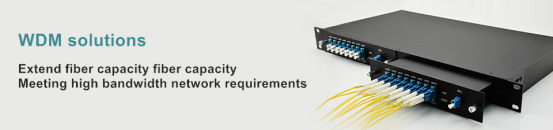
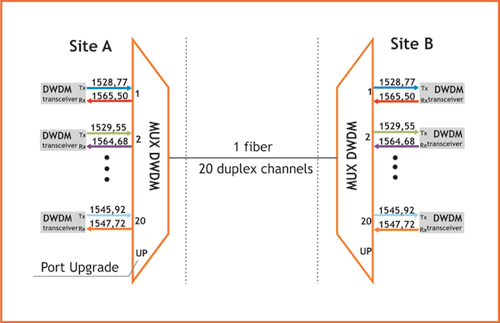
Active devices such as optical fiber amplifiers and dispersion compensators are not used in passive DWDM systems. The transmission distance of this system is limited by the transmit power of the optical transceiver, but it has the advantages of high channel capacity, and is mainly used in the high speed transmission lines of metropolitan area network and high channel capacity.
Passive DWDM only consists of passive MUX/DEMUX multiplexer and DWDM colored optical modules, without EDFA amplifier, DCM dispersion compensation or OEO transponder. The whole system has no powered active equipment, plug-and-play without power supply, maximum transmission distance limited within 40km by optical module launch power and link insertion loss.
Ⅲ. What Is Active DWDM System?
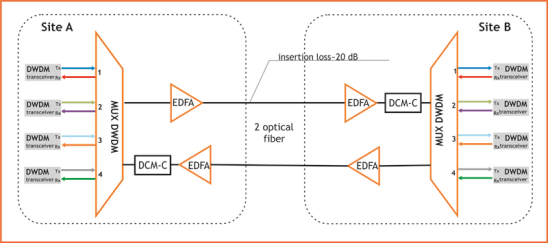
Active DWDM is a system that contains transponders, the function of the transponder is optical electro optical (OEO) conversion. The management and maintenance of active DWDM system is also more complex, so its operation cost is higher. Active DWDM systems are still widely used in large capacity optical transmission applications.
Complete active DWDM system integrates three core active hardware: EDFA optical amplifier, DCM dispersion compensation module and OEO transponder (3R signal regeneration). It can compensate fiber attenuation and chromatic dispersion, realize signal reshaping, retiming and re-amplification, support ultra-long distance transmission over hundreds or thousands of kilometers.
Both passive DWDM and active DWDM have their own pros and cons, which will be described in detail below.
2.Easy to use: passive DWDM is a plug and play system, which is simple and convenient to use.
Even though passive DWDM has the two main benefits, it still has the drawback.
Ⅵ. How To Choose Between Passive DWDM and Active DWDM?
Both passive DWDM systems and active DWDM systems have advantages, and we should deploy appropriate DWDM systems according to specific application requirements. ETU-Link provides a range of DWDM solutions to help you achieve fiber expansion in an economically efficient way. For more details, welcome to contact our sales: sales@etulinktechnology.com.
Last updated: July 16, 2026
Categories
New Blog
Tags
For inquiries about our products or pricelist, please leave your information with us and we will be in touch with in 24 hours.


 Factory: Right Side Of 3rd Floor, No. 102 Building, Longguan Expressway, Dalang Street, Longhua District, Shenzhen
Office: Floor 4, Building 4, Nanshan Yungu Phase ll, Taoyuan Community, XiliStreet,Nanshan District, Shenzhen
© Copyright: 2026 ETU-Link Technology CO ., LTD All Rights Reserved.

IPv6 network supported
Friendly Links:
易天官网