English



Unveiling the Core Technologies of Optical Modules: DML vs. EML--Which Is the Leader in High-Speed Transmission?
Push open the door to the data center, and amidst the humming server racks, countless thin optical fibers are carrying massive amounts of data. At the source of these fibers, a component the size of a fingernail — an optical chip—determines the performance ceiling of the entire communication system.
Today, we'll discuss the most crucial choice for optical modules: direct-modulated lasers (DML) versus electro-absorption modulated lasers (EML).
I. DML: A straightforward and direct approach
By directly changing the injection current of the laser, the light intensity increases with a stronger current and decreases with a weaker current. The fluctuations in optical power thus carry information to the optical fiber.
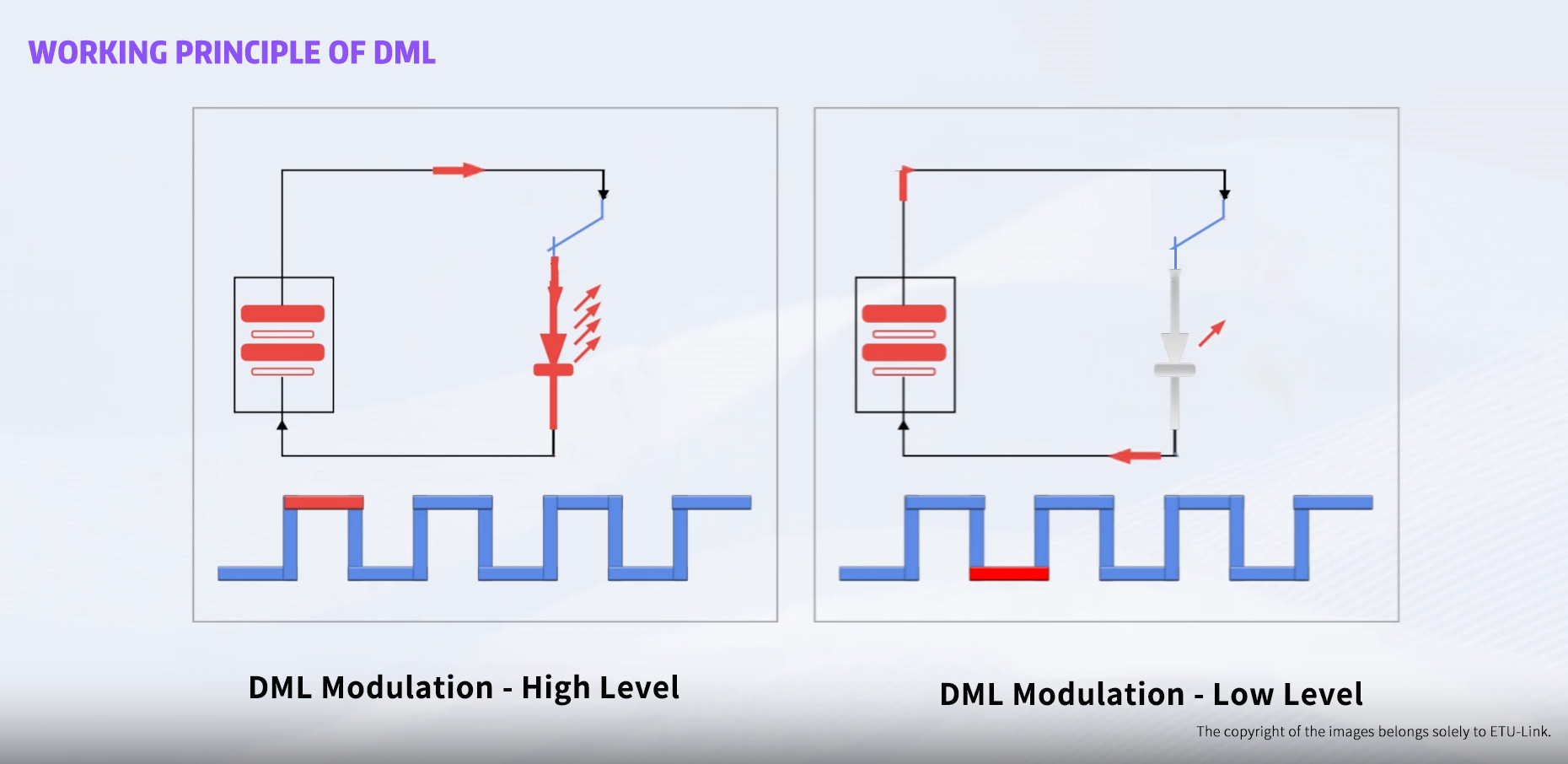
This "direct-to-use" model offers inherent advantages: simple structure, low cost, and low power consumption. In short-distance (SR, Short Reach; single-channel 50 Gband LR ) transmission scenarios, such as server-to-switch connections within data centers, DML has consistently held the title of cost-effectiveness king due to its low power consumption and high cost-performance ratio. For traditional applications with transmission distances ranging from a few hundred meters to 10 kilometers and speeds of 10G/25G, DML performs more than adequately.
II. EML: The "Precision" Approach of Divide and Conquer
But when we turn our attention to 5G fronthaul, metropolitan area networks, and even backbone networks, the story is completely different. As transmission distances extend to 10 kilometers, 40 kilometers, or even 80 kilometers, DML's "straightforward nature" begins to cause trouble.
The core issue lies in the "chirp effect." Simply put, when the current is directly modulated, the change in current not only alters the light intensity but also inadvertently changes the laser's temperature and the refractive index of the active region, causing a wavelength shift. This shift, under the influence of fiber dispersion, causes the light pulse to broaden, resulting in a sharp deterioration in signal quality.
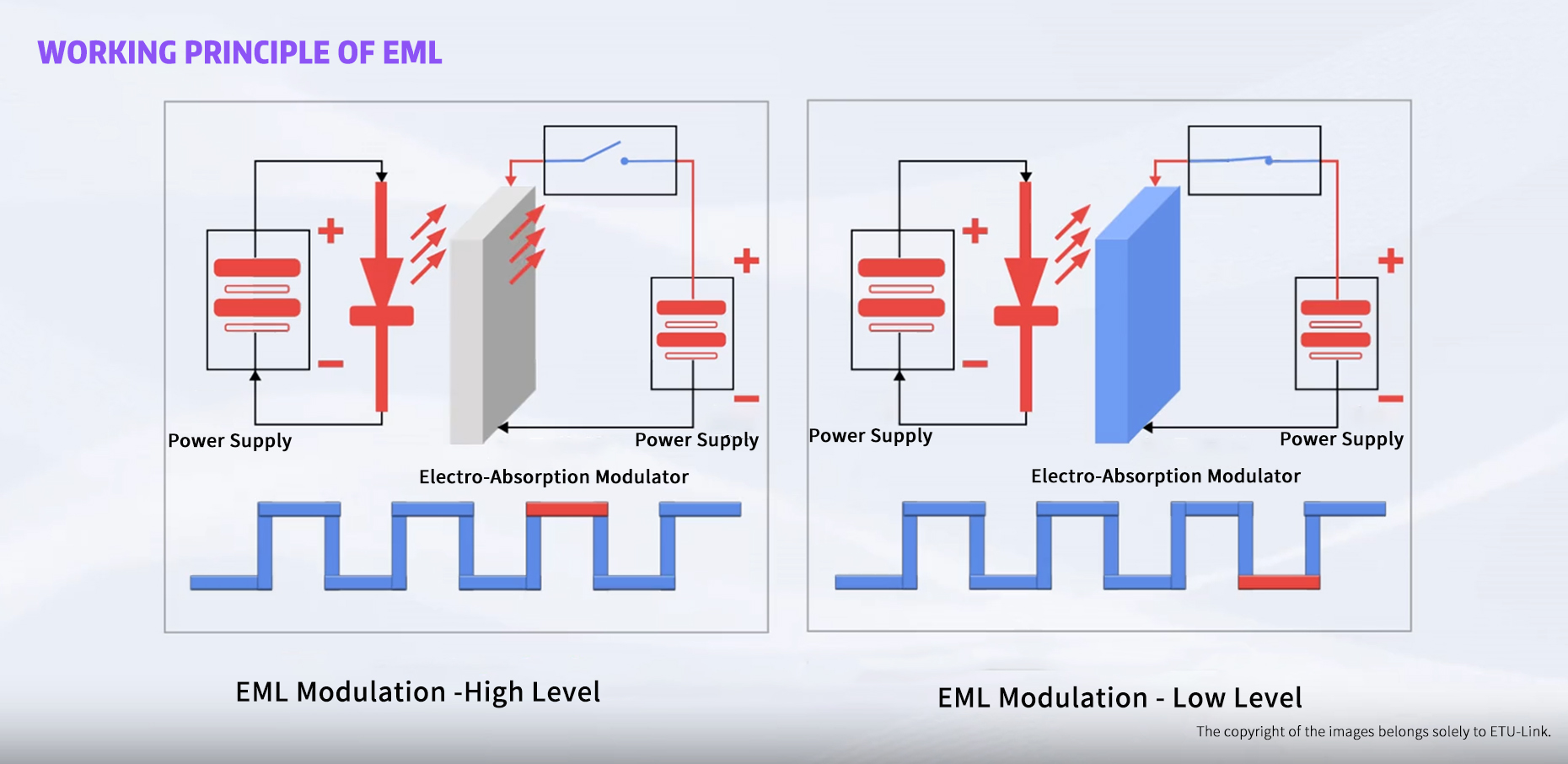
Then, EML came into play.
EML employs the wisdom of "divide and conquer." It integrates the laser (DFB, Distributed Feedback Laser) and the modulator (EAM, Electro-Absorption Modulator) onto the same chip. The laser section simply emits light stably with a constant current and a rock-solid wavelength; the task of signal loading is delegated to the modulator, which controls the amount of light absorbed by changing the voltage.
This division of labor has yielded two revolutionary advantages: extremely low chirp and higher modulation rates. For this reason, EML has become the ideal choice for long-distance (ER) transmission scenarios above 25G. When you need to transmit 10G and above signals over 10 kilometers, or increase the rate to 100G per wave , EML will be a good option .
III. The Game Behind the Selection: The Trade-off Between Cost and Performance
In the eyes of optical communication engineers, the choice between DML and EML is never a simple technical competition, but a game of systems engineering.
The appeal of DML lies in its extreme simplicity. The entire optical module may only require a single driver chip in conjunction with the laser, resulting in a relatively simple circuit design. However, the trade-off is that to suppress chirp effects, it often requires a more complex optical design or the use of special optical fibers.
While EML may seem perfect, it implies higher driving voltage requirements (usually requiring negative voltage), more complex temperature control circuitry, and higher chip costs. The price of an EML laser can be several times that of a DML laser of the same rate.
It is worth noting that with the rise of silicon photonics technology, traditional boundaries are becoming blurred. Silicon photonic modulators are also based on electroabsorption or the Mach-Zehnder effect, and in today's pursuit of ultimate energy efficiency and integration, EML's market share is being challenged by silicon photonics solutions.
There is no absolute king between DML and EML, only the most suitable battlefield.
If you're dealing with interconnects within a data center spanning only a few hundred meters and are prioritizing extreme power consumption and cost, DML is your ideal partner. However, if you're undertaking long-distance cross-city missions and need to ensure signal fidelity despite the challenges of dispersion and noise, then EML is the obvious choice.
For inquiries about our products or pricelist, please leave your information with us and we will be in touch with in 24 hours.


 13th Floor, Building 6, Honghualing Base, Nanshan Intelligent Manufacturing Base, Liuxian Avenue, Taoyuan Street, Xili, Nanshan District, Shenzhen, China
© Copyright: 2026 ETU-Link Technology CO ., LTD All Rights Reserved.

IPv6 network supported
Friendly Links:
易天官网