English




Why has AI become the focus of widespread attention?
Open any news outlet, and you'll find AI almost everywhere. Some are discussing breakthroughs in large-scale modeling technology, while others worry about job losses. Governments around the world are rolling out AI strategies, and capital is pouring into computing power and chip manufacturing.
Why has artificial intelligence become the core issue sweeping the globe? The answer lies not only in the technology itself. The real key is that AI simultaneously plays a triple role: an engine of global economic growth, a strategic arena for great power competition, and a variable in social change. This intertwining of multiple identities allows its influence to penetrate industries, nations, and individuals; no one can remain unaffected.
Ⅰ. An Economic Boost: One of the Few Engines of Growth in Turbulent Times
The global economy is currently under pressure, geopolitical conflicts continue to cause disturbances, and many industries are experiencing sluggish growth, but artificial intelligence is one of the few bright spots for growth.
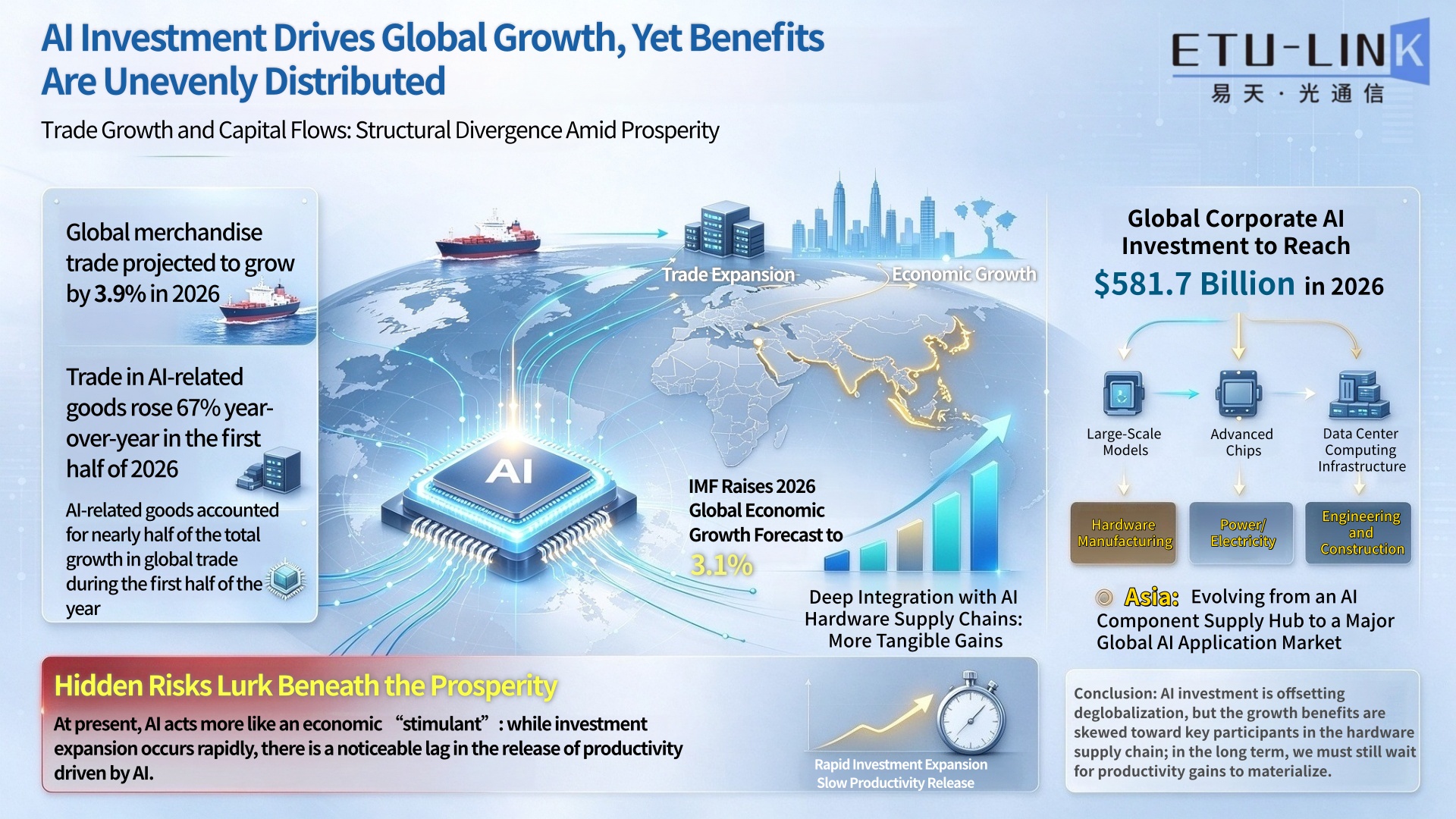
According to WTO estimates, driven by strong AI investment, global merchandise trade is projected to grow by 3.9% in 2026. In the first half of 2026, global trade in AI-related goods such as semiconductors and servers surged by 67% year-on-year. Data from the Institute of International Finance shows that AI-related goods contributed nearly half of the increase in global merchandise trade in the first half of the year, effectively offsetting the trend of "de-globalization." Asia is no longer just a supplier of AI components; it is rapidly growing into a major global market for AI applications.
The IMF raised its 2026 global economic growth forecast to 3.1% , believing that the AI investment boom has offset some of the economic drag from geopolitical conflicts. However, the benefits are not evenly distributed: economies deeply integrated into the AI hardware supply chain are reaping more significant gains, further exacerbating the global growth divergence.
From a capital perspective, global corporate AI investment reached $581.7 billion in 2025 , with massive amounts of capital flowing into large-scale models, advanced chips, and data center computing infrastructure. This will boost demand in the short term for hardware manufacturing, electricity, and engineering construction. However, economists also soberly warn that AI is currently more like an economic "stimulant." Investment expansion is rapid, but the release of productivity brought about by AI empowerment has a significant time lag. Beneath this prosperity, hidden dangers also lurk.
Ⅱ. Opportunities in Niche Sectors: Optical Modules Enter a Supercycle

The large-scale construction of AI computing clusters has also spurred explosive growth in the niche hardware sector of optical modules. Optical modules are the "photonic blood vessels" of computing networks, responsible for converting electrical signals to optical signals, and are core components for high-speed interconnection between massive numbers of GPUs. Training large models requires the collaborative computation of tens of thousands of GPUs; traditional copper cable transmission suffers from insufficient bandwidth and high losses, making high-speed optical interconnection an essential path to overcome computing power bottlenecks.
With the explosive growth in demand for AI computing power, the industry has entered a boom phase of simultaneous increases in both volume and price : 800G optical modules have been commercially deployed on a large scale, 1.6T is accelerating its rollout, and 3.2T co-packaged optical technology with CPO has entered the cutting-edge R&D and verification stage. According to institutional estimates, the construction of AI data centers continues to drive up the market size of high-speed optical modules, and overseas cloud vendors continue to increase their capital expenditures, resulting in a full order book for high-speed optical modules.
For domestic optical module companies, this is not only an opportunity for market expansion, but also a window to unleash the advantages of the domestic industry. Chinese manufacturers hold a significant share of the global high-speed optical module market, leveraging their mature manufacturing capabilities and technological iteration capabilities to deeply participate in the construction of global AI computing infrastructure, upgrading from traditional communication device suppliers to core participants in the AI computing power foundation. Of course, challenges also lie behind these opportunities: high-speed products significantly raise the technical barriers to optoelectronic chips, packaging, and heat dissipation, and the pace of technological iteration accelerates. Companies need to continuously invest in R&D to maintain their competitive advantage.
Ⅲ. Behind the Prosperity: Three Concerns—Bubbles, Employment, and Governance
The other side of the capital frenzy is a series of deep-seated risks, which is also the core reason why ordinary people continue to pay attention to AI.
1. AI Investments May Not Deliver Real Returns
A Gartner survey reveals that 44% of CEOs cannot demonstrate to shareholders that AI delivers tangible financial returns. Many companies are simply adding AI to their existing businesses, which rarely generates value; a complete restructuring of their business models is necessary to unlock its benefits. More alarmingly, about one-third of the funding in the AI boom comes from debt financing. Upstream companies are massively expanding production to meet orders, and if market demand falls short of expectations, it could easily trigger a chain reaction of debt adjustments, raising concerns about a repeat of asset bubbles.
2. Beware of the “Engels Stagnation” in the AI Era
AI is not simply about cutting jobs; it's about reshaping the skill thresholds for those jobs. Data shows that labor demand in industries with high AI exposure has decreased by 10%, meaning only workers with new skills will be able to capitalize on the benefits. Historically, the Industrial Revolution saw the "Engels Stagnation": productivity surged, but wages for ordinary workers stagnated for a long period, with technological gains flowing largely to capital. Scholars worry that the AI era may repeat this scenario: technological efficiency will soar, but income growth for ordinary people will slow, widening the wealth gap and impacting the existing fiscal and tax distribution system. This is precisely the source of public anxiety about employment.
3. Technology Is Advancing Too Fast, and Governance Can’t Keep Up
The Stanford AI Index 2026 report shows that the number of recorded AI security incidents surged from 233 in 2025 to 362, an increase of over 55%. Deepfakes, privacy breaches, and algorithmic bias incidents are frequent; the problem of large-scale model illusions remains unresolved, and the transparency of some cutting-edge AI companies has actually declined. Meanwhile, the large-scale expansion of data centers is consuming vast amounts of water and electricity, causing conflicts in local communities, and the resource pressures brought about by technological development are gradually becoming apparent. Security assessments and regulatory rules consistently lag behind the pace of model iteration.
Ⅳ. Great Power Rivalry: AI Sovereignty Becomes a Battleground for Nations
Artificial intelligence has risen to the level of a nation's core competitiveness. The competition is no longer just about comparing model parameters, but about vying for comprehensive discourse power in computing power, data, talent, and rules.
China and the US are the core forces in global large-scale model development. The World Economic Forum predicts that the technological gap between China and the US in large-scale model development will continue to narrow over the next 12 months. China has clearly identified artificial intelligence as a key variable influencing future development, comprehensively promoting the "AI+" initiative. Relying on a complete industrial system and a vast number of application scenarios, China insists on driving technological innovation through practical applications, focusing on empowering the real economy, balancing development and security, and strengthening the foundation of computing power, algorithms, and data.
Not only China and the United States, but also a large number of emerging economies have introduced national-level AI strategies and begun to pursue artificial intelligence sovereignty : to independently control computing power, data, models, and talent, and to take the lead in their own AI development.
AI risks inherently possess cross-border transmission characteristics; deepfakes, data security, and algorithmic risks are not hindered by national borders. No single country can address these risks independently; the international community calls for multilateral collaborative governance and the establishment of universal AI governance standards. Simultaneously, it is important to consider the needs of countries in the Global South, avoiding the need for them to forcibly develop cutting-edge large-scale models independently, but rather to share the benefits of technology through localized AI applications and worker skills training.
In conclusion
AI captivates the world because it stands at the intersection of three forces: the hope for economic growth, the fear of social stratification, and the strategic high ground of national competition.
It is both a highly promising productivity tool and a complex force that requires careful management. Technology itself is neither good nor evil; the real challenge lies in how humanity can balance innovation, inclusiveness, and security , ensuring that the benefits of AI reach more people rather than exacerbating the gap. This is a shared challenge for all humankind.
Categories
New Blog
Tags
For inquiries about our products or pricelist, please leave your information with us and we will be in touch with in 24 hours.


 13th Floor, Building 6, Honghualing Base, Nanshan Intelligent Manufacturing Base, Liuxian Avenue, Taoyuan Street, Xili, Nanshan District, Shenzhen, China
© Copyright: 2026 ETU-Link Technology CO ., LTD All Rights Reserved.

IPv6 network supported
Friendly Links:
易天官网