English




How to distinguish the wavelength form the ring color of the optical transceiver?
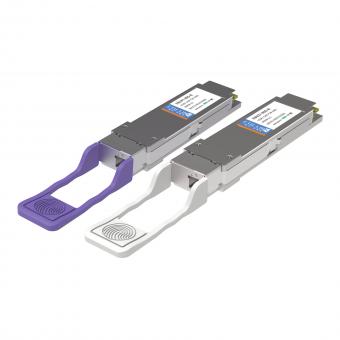
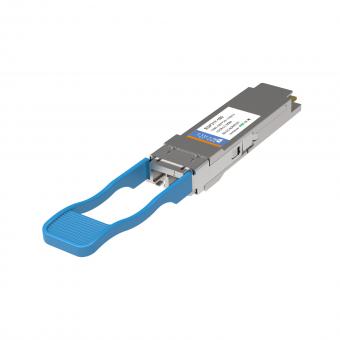
Optical transceivers are essential components in fiber optic communication, data center interconnection, and network transmission systems. The ring color of the optical transceivers are colorful, different colors corresponding to different wavelength. In order to make the new colleagues to be more convenient and more quickly to distinguish each color corresponds to the wavelength,especially for SFP, SFP+ and other mainstream optical modules, the following is a a simple summary.
1. The commonly used wavelength corresponds to the ring color
These standards apply to most traditional optical transceivers for short‑haul and medium‑haul transmission:
850nm —— Black
1310nm —— Blue
1490nm —— Purple
1550nm —— Yellow
1) Black: Typically indicates a standard wavelength such as 850nm for multimode fiber (MMF) . These are commonly used for short-range transmissions, often found in SX transceivers.
2) Blue: Generally denotes a 1310nm wavelength for single-mode fiber (SMF) . This is standard for LX or LH transceivers, used for medium to long distances.
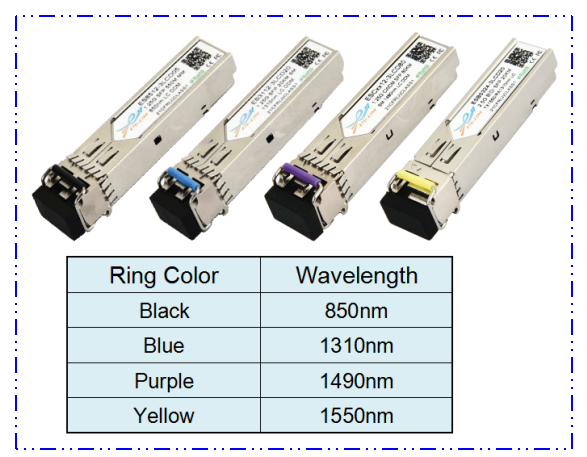
Note: Usually the ring of 1550nm wavelength is green.
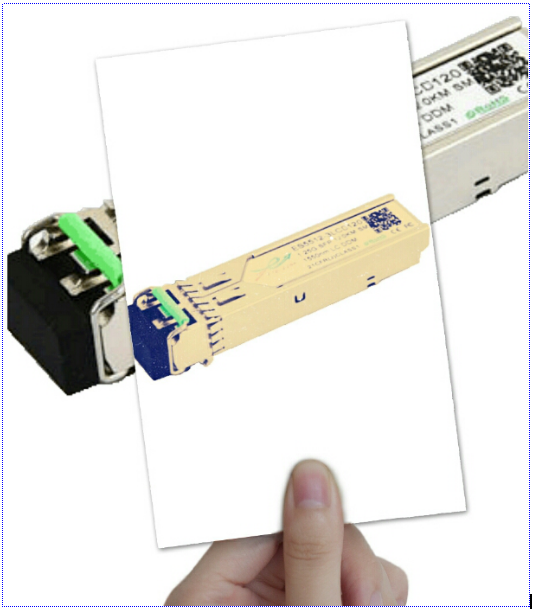
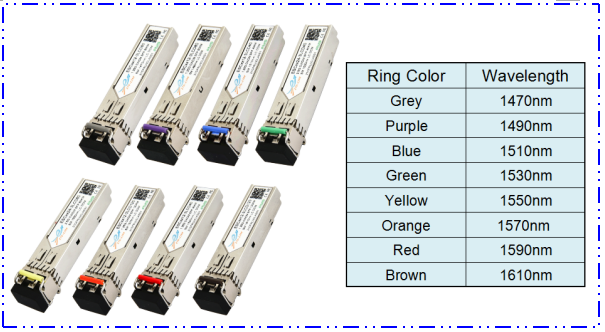
2. The corresponding color for each wavelength of CWDM module
CWDM (Coarse Wavelength Division Multiplexing) optical modules follow a dedicated color‑coding system for long‑distance and multi‑wavelength transmission:
1470nm —— Grey
1490nm —— Purple
1510nm —— Blue
1530nm —— Green
1550nm —— Yellow
1570nm —— Orange
1590nm —— Red
1610nm —— Brown
Why Wavelength Identification Matters?
Using the correct fiber optic transceiver wavelength is essential for network integrity. Mismatched wavelengths—such as connecting an 850nm multimode transceiver to a 1310nm single-mode line—can lead to excessive signal loss, link instability, or complete network failure. By learning to identify SFP wavelength by color, technicians can quickly verify compatibility during installation or troubleshooting.
Exceptions and Best Practices
While the ring color is a helpful visual indicator, it is not a definitive standard. Some manufacturers use custom colors or do not follow the industry code. Therefore, it is always recommended to:
Check the Label: Every optical module has a label specifying the wavelength (e.g., 850nm, 1310nm, 1550nm), as well as the fiber type (SMF or MMF) and transmission distance.
Verify with a Digital Diagnostic Optical Monitoring (DDOM) Interface: If the transceiver is installed in a managed switch, you can use the DOM interface to read the real-time wavelength and optical parameters.
Consult the Data Sheet: For critical deployments, always refer to the manufacturer’s specifications to confirm the transceiver ring color wavelength mapping.
Although today's content seems very simple, but it is also very important, we need to pay special attention to this. Mastering ring color rules helps improve installation, maintenance, and troubleshooting efficiency for optical transceivers, optical modules, and fiber optic networks. Hope these content will be useful to everyone!
Last updated: March 25, 2026
For inquiries about our products or pricelist, please leave your information with us and we will be in touch with in 24 hours.


 13th Floor, Building 6, Honghualing Base, Nanshan Intelligent Manufacturing Base, Liuxian Avenue, Taoyuan Street, Xili, Nanshan District, Shenzhen, China
© Copyright: 2026 ETU-Link Technology CO ., LTD All Rights Reserved.

IPv6 network supported
Friendly Links:
易天官网