English



The difference between single and dual fiber optical transceiver
There are single-fiber and dual-fiber optical transceivers. How do we choose, and what are their differences and advantages? Let’s learn about this!
Common wavelength of BIDI optical module
SFP BIDI:TX1310nm/RX1550nm; TX1550nm/RX1310nm;TX1490nm/RX1550nm; TX1550nm/RX1490nm;TX1310nm/Rx1490nm; TX1490nm/Rx1310nm.

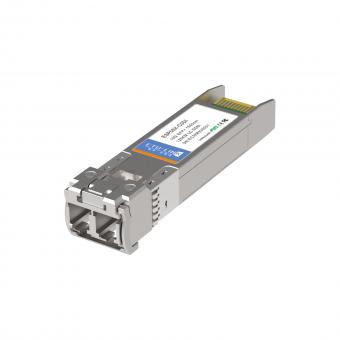
10G SFP+ BIDI: TX1270/RX1330nm; TX1330/RX1270nm

What is a Dual-Fiber Transceiver?
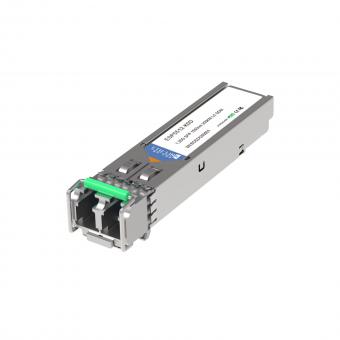
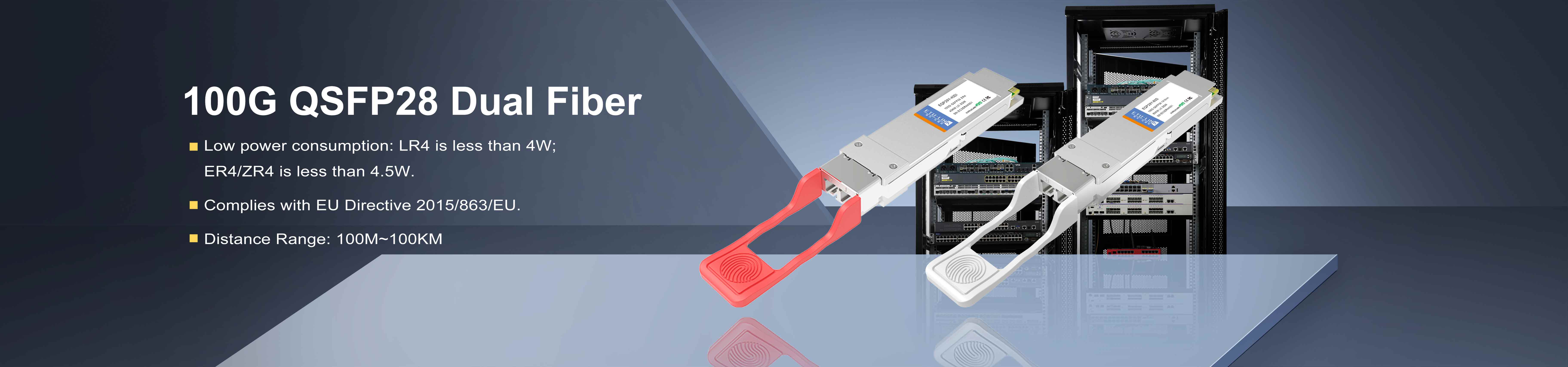
Dual fiber module has two ports, TX is transmitting port, RX is receiving port. Both transmitting and receiving needs one optical fiber, so it requires two fibers for a single link.
The advantages of BIDI module: BIDI optical module is relatively expensive in unit price, but save fiber resources, only need one fiber. It is a better choice for users with insufficient fiber resources or those looking to upgrade fiber optic network without laying new cables.
The advantages of dual fiber module: The both ends module don't need to be used in pairs, any 2 can be connected. It's cheaper than the BiDi SFP optical module. But needs two fibers, can choose the dual-fiber module if the optical fiber resources are sufficient.
Cost Analysis: Which is More Economical?
How single-fiber modules to save fiber resources? Let's do a simple cost calculation:
For example: Dual-fiber module is $6/pcs, BiDi SFP for sale is $10/pcs, patch cord is $0.15/pcs.
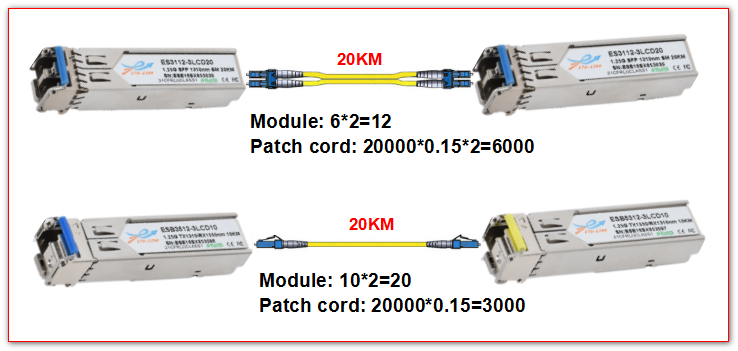
ETU-Link BiDi and Dual-Fiber Solutions
BiDi optical module may be a little expensive than the common optical module, but it can save you the cost of optical cable from the whole network program.
https://www.etulinktechnology.com/sfp_c27
Categories
New Blog
Tags
For inquiries about our products or pricelist, please leave your information with us and we will be in touch with in 24 hours.


 13th Floor, Building 6, Honghualing Base, Nanshan Intelligent Manufacturing Base, Liuxian Avenue, Taoyuan Street, Xili, Nanshan District, Shenzhen, China
© Copyright: 2026 ETU-Link Technology CO ., LTD All Rights Reserved.

IPv6 network supported
Friendly Links:
易天官网