English



What Are Eye Diagram Fundamentals?
In high-speed optical communication, data center transmission, and optical module testing, the eye diagram (eye pattern) is one of the most important tools to evaluate signal integrity (SI) and transmission quality. This article explains the definition, principles, applications, and judgment criteria of eye diagrams for optical modules and fiber optic systems.
1. What Is an Eye Diagram (Eye Pattern)?
In telecommunication, an eye pattern, also known as an eye diagram.Eye diagram is a series of digital signal accumulate on the oscilloscope and form a graph,it’s shape is similar to the eye,so called eye diagram.
The eye diagram is formed by superimposing high-speed digital signals on an oscilloscope, which visually reflects signal distortion, jitter, attenuation, and noise during transmission.
2. Why Is Eye Diagram Important in Optical Communications?
An eye diagram is a common indicator of the quality of signals in high-speed digital transmissions. Eye diagrams usually include voltage and time samples of the data acquired at some sample rate below the data rate.
A perfect eye diagram contains an immense amount of parametric information about a signal, like the effects deriving from physics, irrespective of how infrequently these effects occur.
Eye diagrams provide instant visual data that engineers can use to check the signal integrity of a design and uncover problems early in the design process.
Used in conjunction with other measurements such as bit-error rate, an eye diagram can help a designer predict performance and identify possible sources of problems.
In optical module manufacturing (SFP, SFP+, 10G, 25G, 100G), eye diagram testing is a mandatory quality inspection item. A clear, wide, and stable eye represents excellent transmission performance.
3. How to Judge Signal Quality from an Eye Diagram?
In the testing, it is close relationship between "eye pattern" and "quality". if the eye pattern is good and stable, that is mean the module's quality is good.
There are various shapes of the eye,the eye diagram also.We can quickly judge the signal quality by the shape characteristics of the eye diagram.
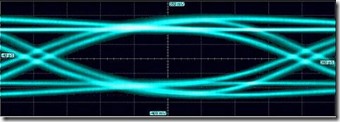
1). What Does a “Double Eyelid” Eye Diagram Mean?
The below eye diagram of "double eyelid",can judge that the signal may crosstalk or pre (go) aggravation.
This shape usually indicates internal crosstalk, improper pre-emphasis, or suboptimal PCB design in the optical module or circuit.
2). What Does a “Bloodshot Eyes” Eye Diagram Mean?
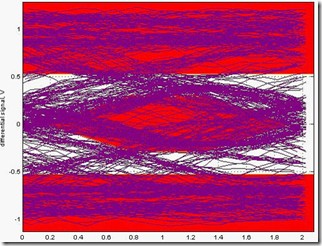
The below eye diagram "bloodshot eyes",this indicates poor signal quality,test methods may be wrong, also may be PCB layout has an obvious error.
Severe “bloodshot” appearance means high noise, large jitter, incorrect test setup, or poor impedance matching in high-speed links.
3) What Does a Standard Complete Eye Diagram Look Like?
A complete eye diagram should contain from "000" to "111" in all state group, 8 states formed an eye diagram,picture as below:
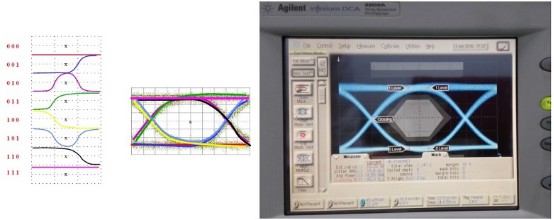
The effect of termination is clearly visible in the eye diagrams generated.
A standard compliant eye diagram includes complete 0/1 level transitions, clear eye opening, stable amplitude, and meets IEEE and MSA standards for optical transceivers.
4. Eye Diagram Test Application in Optical Modules
In order to make the products work steady we testing the eyediagram by bare fiber (20km/40km/80km), ETU-LINK tests eye diagrams under different fiber distances (20km, 40km, 80km) to verify long-distance transmission stability, low insertion loss, and high signal integrity for optical modules and optical fibers.
ETU-Link technology Co., LTD are always a reliable and professional partner, we supply Lower insert loss optical fiber for you and would like to develop with you together!
Related reading: Finisar Active optical cable Gigabit Ethernet media converter
Last updated: April 10, 2026
Previous :
The Training of ProductsFor inquiries about our products or pricelist, please leave your information with us and we will be in touch with in 24 hours.


 13th Floor, Building 6, Honghualing Base, Nanshan Intelligent Manufacturing Base, Liuxian Avenue, Taoyuan Street, Xili, Nanshan District, Shenzhen, China
© Copyright: 2026 ETU-Link Technology CO ., LTD All Rights Reserved.

IPv6 network supported
Friendly Links:
易天官网