English



LAN vs WAN vs MAN vs VLAN vs VPN
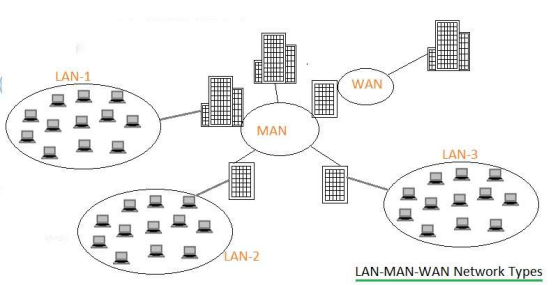
Parameters
LAN
MAN
WAN
Full Form
Local Area Network
Metropolitan Area Network
Wide Area Network
What is it?
• Systems are close to each other in LAN
• contained in one office or building
• one organization can have several LANs
• Large network which connects different organizations
• Two or more LANs connected
• Located over large geographical area
Distance coverage
Limited coverage, about up to 2 miles (or 2500 meters)
Limited coverage, about up to 100 miles (or 200 km)
Unlimited (usually in 1000Km) range, uses repeater and other connectivity for range extension
Speed of operation
High, typically 10, 100 and 1000 Mbps
High, typically 100 Mbps
Slow, about 1.5 Mbps (May vary based on wireless technologies used)
Technologies used for medium
Locally installed, twisted pair, fiber optic cable, wireless (e.g. WLAN, Zigbee)
Locally installed and based on common carrier e.g. twisted pair, fiber optic cable etc.
Locally installed and based on common carrier e.g. twisted pair wires, fiber, coaxial cable, wireless including wireless and cellular network based
Applications
Used mainly by fixed desktop computers and portable computers (e.g. laptops). Now-a-days it is used by smart phones due to emergence of WLAN network
Used mainly by desktop and mini computers.
Can be used by any devices, but desktop devices are mainly using this network type.
In short:
LAN: Small area (home, office, building)
MAN: City‑level area (campus, urban district)
WAN: Global area (internet, cross‑city/country)
What Is the Difference Between VLAN and VPN?
※ VLAN stands for Virtual Local Area Network. It is a set of hosts that communicate with each other as if they were connected to the same switch (as if they were in the same domain), even if they are not.
※ VPN stands for Virtual Private Network. It provides a secure method for connecting to a private network through a public network that is not secure, such as the internet from a remote location.
※ VPN allows creating a smaller sub network using the hosts in an underlying larger network and a VLAN can be seen as a sub group of VPN. The main purpose of VPN is to provide a secure method for connecting in a private network, from remote locations.
Hope these information will be helpful for you! http://www.etulinktechnology.com/
Last updated: May 19, 2026
Previous :
How to write a good emailNext :
Workshop dress standardFor inquiries about our products or pricelist, please leave your information with us and we will be in touch with in 24 hours.


 13th Floor, Building 6, Honghualing Base, Nanshan Intelligent Manufacturing Base, Liuxian Avenue, Taoyuan Street, Xili, Nanshan District, Shenzhen, China
© Copyright: 2026 ETU-Link Technology CO ., LTD All Rights Reserved.

IPv6 network supported
Friendly Links:
易天官网