English



What is the use of CDR clock data recovery in optical modules?
In high-speed fiber-optic communication, data centers, and long-haul transmission systems, signal integrity is critical. Clock and Data Recovery (CDR) is a core function that ensures stable, error-free transmission for optical modules. Today, ETU-LINK will introduce to you what exactly is CDR clock data recovery: working principle, key roles, industry standards, and typical applications.
The CDR clock data recovery function plays a vital role in the signal transmission process of the optical module.
The full name of CDR is clock and data recovery, which can be simply understood as: after the optical signal is converted into an electrical signal, the receiver performs electrical domain shaping and clock recovery. CDR has two main functions: the first is to provide clock signal for each circuit of receiver; The second is to judge the received signal, which is convenient for data signal recovery and subsequent processing.
CDR complies with IEEE 802.3ae and SFF-8431 industry standards for high-speed optical transceivers, which define jitter performance and lock-time requirements.
2. Why Do Optical Modules Need CDR Function?
Because when the optical signal is transmitted to a certain distance, it is usually long-distance transmission, and its waveform will appear a certain degree of distortion. The signals received by the receiver are pulse signals of different lengths. At this time, at the receiver, we can not get the data we need. Therefore, signal regeneration is needed at this time. Signal regeneration functions include re amplification, re shaping and re timing. Re-timing refers to CDR clock data recovery. According to optical transmission industry data, CDR reduces bit error rate (BER) to below 10⁻¹² and effectively compensates for waveform distortion caused by fiber loss, dispersion, and noise interference.
3. What is the Core Function of CDR in Optical Modules?
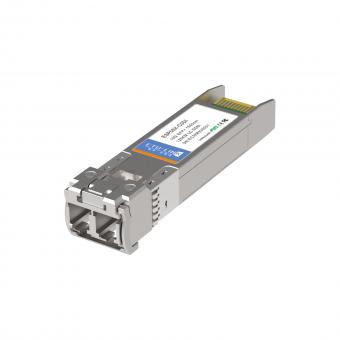
In a word, the biggest function of CDR clock data recovery function in optical module is to make the signal of receiver consistent with that of transmitter. Generally, CDR optical modules are used, most of which are high-speed and long-distance transmission optical modules. For example, 10G SFP+ ER / 10G SFP+ ZR optical modules are generally used. Optical modules using CDR chips will be rate locked and cannot be used for frequency reduction. CDR completes re-timing, re-shaping, and re-amplification (3R regeneration), which is essential for long-haul 10G, 25G, 100G, and 400G optical modules.
4. What Are the Typical Applications of CDR Optical Modules?
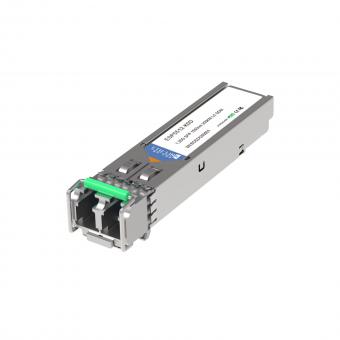
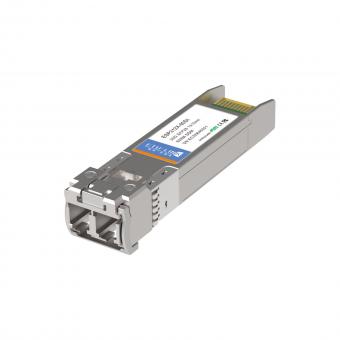
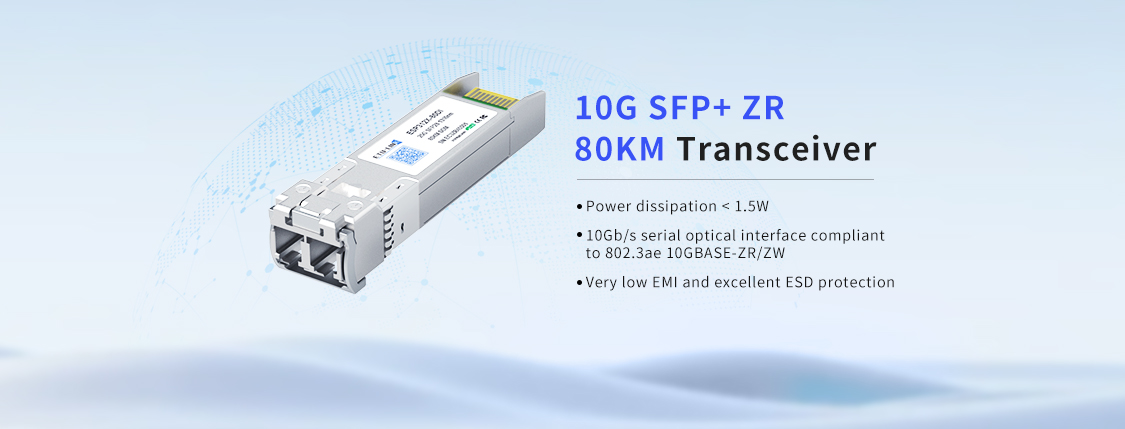
The 10G SFP+ ER/ZR of ETU-LINK is equipped with CDR chip, and the connector is duplex LC. It supports two working temperatures of industrial and commercial level. The farthest transmission distance can reach 80 km through single-mode optical patch cord. It is widely used in 10G Ethernet, optical transmission network and 10G Optical fiber channel. These modules comply with SFP+ MSA and SFF-8472 DDM specifications, supporting commercial (0~70°C) and industrial (-40~85°C) temperature ranges.
5. In Which Fields is CDR Technology Widely Used?
As a very important electrical chip in optical module, CDR chip is related to the quality of received signal in high-speed communication. It is widely used in telecommunications, optical media converter, data center storage LAN and wireless products. Industry research shows CDR modules reduce power consumption by up to 24% and latency by 100x compared with DSP-based schemes, widely used in 5G fronthaul, data centers, and OTN transmission.
Last updated: April 2, 2026
For inquiries about our products or pricelist, please leave your information with us and we will be in touch with in 24 hours.


 13th Floor, Building 6, Honghualing Base, Nanshan Intelligent Manufacturing Base, Liuxian Avenue, Taoyuan Street, Xili, Nanshan District, Shenzhen, China
© Copyright: 2026 ETU-Link Technology CO ., LTD All Rights Reserved.

IPv6 network supported
Friendly Links:
易天官网